Startup Fundraising in 2026: Why Virtual Data Rooms (VDRs) Are Essential for Venture Capital Due Diligence
How founders, startups and venture capital firms are using Virtual Data Rooms to accelerate fundraising in 2026. India’s startup ecosystem continues to evolve at an extraordinary pace. From AI-driven startups and SaaS companies to fintech, healthtech and climate-tech innovators, founders are raising capital from angel investors, venture capital firms, family offices and institutional investors at unprecedented levels.
While sharing information conveniently is paramount, what is also important is that information is not easily shareable via a OneDrive or Google link. Revealing business secrets to investors and competitors is damaging for any company and especially so at the startup stage. Having granular access with time-based and role-based access is critical for any serious startup.
Attracting investor interest is no longer the biggest challenge.
The real challenge is being investor-ready.
Modern venture capital firms have become increasingly selective. Investors now expect startups to demonstrate operational maturity, governance discipline and the ability to provide accurate information quickly and securely.
A compelling pitch deck may open the door, but investors commit capital only after conducting extensive due diligence.
A VDR clearly demonstrates professionalism and preparedness in more than a subtle way. This is why they are rapidly becoming an essential part of startup fundraising.
Platforms like Right2Data VDR for startups help founders organise, secure and manage confidential information throughout the fundraising lifecycle while providing investors with a transparent and professional due diligence experience.
The Startup Fundraising Landscape in 2026
Global venture capital markets have become significantly more disciplined over the past few years.
Investors are focusing less on rapid growth at any cost and more on:
- Sustainable business models
- Strong unit economics
- Governance practices
- Regulatory compliance
- Data security
- Intellectual property ownership
- Scalability
As a result, fundraising has become increasingly data-driven.
Whether raising:
- Pre-Seed Funding
- Seed Funding
- Series A
- Series B
- Growth Capital
- Strategic Investments
Investors expect immediate access to well-organised information.
Startups that cannot provide documentation quickly often experience delays in closing funding rounds.
Why Investors Conduct Due Diligence Before Investing
Raising capital is no longer just about presenting a compelling pitch deck or showcasing impressive growth numbers. In 2026, venture capital firms, institutional investors and family offices are placing greater emphasis on transparency, governance and operational readiness before making investment decisions.
Before committing capital, investors need assurance that the business is sustainable, compliant and capable of scaling responsibly. This validation process is known as investor due diligence.
In simple terms, due diligence is a detailed investigation that helps investors verify whether a startup is truly investment-ready.
Today, this process has become more data-intensive and time-sensitive than ever before. Investors expect startups to provide accurate information quickly, securely and in a well-organised manner.
This is why many founders are adopting Right2Data VDR, a secure Virtual Data Room platform that centralises confidential information and simplifies investor due diligence.
Instead of relying on scattered email attachments, spreadsheets or generic cloud storage platforms, startups can create a professional and secure environment where investors can review information efficiently.
What Do Investors Evaluate During Due Diligence?
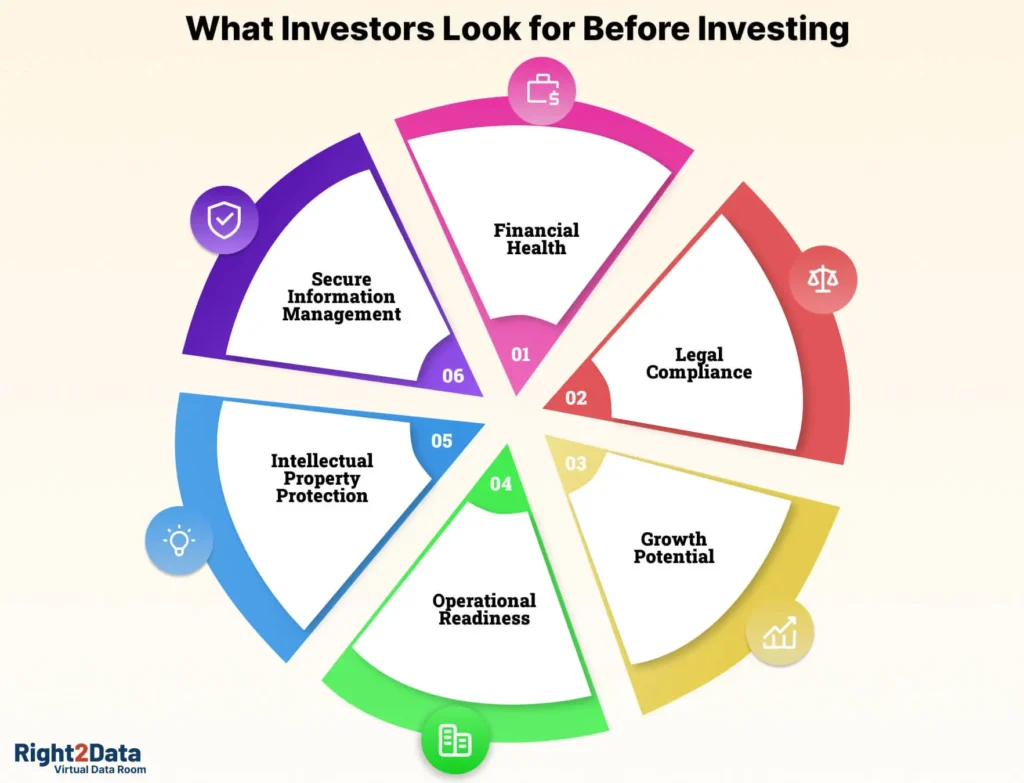
While every investor may have specific requirements, most venture capital firms focus on a few critical areas before making an investment decision.
-
Financial Stability
Investors review the startup’s financial health to understand its growth trajectory and sustainability.
They typically examine:
- Revenue performance
- Cash flow management
- Burn rate
- Profitability metrics
- Financial projections
-
Legal and Regulatory Compliance
Investors want to ensure there are no hidden legal risks that could impact future growth.
They commonly review:
- Incorporation documents
- Licenses and approvals
- Employment agreements
- Customer and vendor contracts
- Ongoing or past litigation
-
Intellectual Property Ownership
For technology-driven startups, intellectual property is often one of the company’s most valuable assets.
Investors verify:
- Patent ownership
- Trademark registrations
- Proprietary technologies
- Software ownership rights
-
Operational Readiness
Strong operations often indicate a company’s ability to scale effectively.
Investors assess:
- Leadership structure
- Internal processes
- Reporting mechanisms
- Governance practices
-
Growth Potential
Investors need confidence that the startup can grow sustainably.
They evaluate:
- Customer acquisition
- Retention rates
- Market opportunity
- Product scalability
Startup Fundraising Checklist: Documents Every VDR Should Include
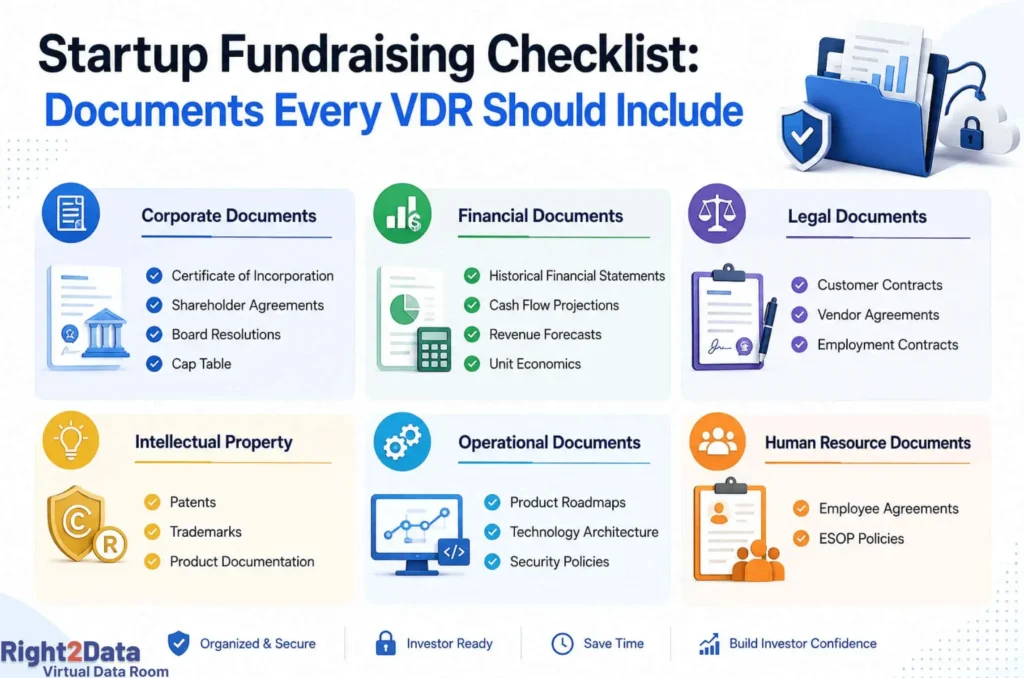
Having these documents ready significantly improves fundraising efficiency.
How Venture Capital Firms Benefit from VDRs
Investors also benefit greatly from structured data rooms.
Advantages include:
- Faster Evaluations: Quick access to organised information.
- Better Collaboration: Internal investment teams can review documents simultaneously.
- Improved Risk Assessment: Auditability improves decision-making.
- Enhanced Security: Confidential information remains protected.
Common Startup Fundraising Mistakes to Avoid
Many startups lose momentum due to poor preparation.
Avoid these common mistakes:
- Waiting Until Investors Ask for Documents: Prepare documentation before fundraising begins.
- Using Generic File-Sharing Platforms: Secure VDRs provide significantly better control.
- Sharing Sensitive Information Too Early: Use permission controls strategically.
- Ignoring Governance: Investors evaluate operational maturity carefully.
- Maintaining Poor Version Control: Always keep information current.
Why Startups Choose Right2Data VDR
Right2Data VDR helps startups prepare for fundraising with enterprise-grade security features and transaction-focused workflows.
- Secure Document Sharing: Protect confidential information throughout the fundraising process.
- Granular Permissions: Control who sees what.
- Dynamic Watermarking: Improve accountability.
- Multiple Admin Controls: Enable founders, CFOs and advisors to collaborate.
- Detailed Audit Logs: Track investor activity.
- Secure Q&A Workflows: Manage investor communications efficiently.
- OTP Authentication: Enhance access security.
- Bulk Uploads and Indexing: Accelerate document organisation.
- India-Hosted Infrastructure: Support data residency requirements.
- Affordable Pricing: Scalable plans suitable for startups and growth-stage companies.
Why Traditional File Sharing Slows Down Due Diligence
Many startups still rely on tools like:
- Email attachments
- Google Drive
- Dropbox
- Shared folders
While these tools may work internally, they are not designed for confidential and time-based information sharing and fundraising activities. Even an investor would not want their data to be shared with other investors as soon as a transaction is imminent.
This often creates challenges such as:
- Multiple document versions
- Uncontrolled sharing
- Limited visibility into investor activity
- Security risks
- Delays in responding to investor requests
As fundraising becomes increasingly competitive, these inefficiencies can directly impact investor confidence.
How Right2Data VDR Simplifies Investor Due Diligence
A structured Virtual Data Room helps founders present information professionally while maintaining complete control over sensitive documents.
Right2Data VDR enables startups to create an investor-ready environment that accelerates due diligence and improves collaboration.
Key capabilities include:
- Secure Document Sharing: Share confidential business information without relying on unsecured email attachments.
- Role-Based Access Controls: Assign different permission levels to investors, advisors and legal teams.
- Dynamic Watermarking: Protect sensitive documents by automatically displaying user details on viewed files.
- Detailed Audit Trails: Track investor activity, document views and engagement levels in real time.
- Centralised Document Organisation: Keep all fundraising documents in a single, structured repository.
- Faster Investor Reviews: Reduce delays by allowing investors to access information instantly.
Why an Organised Data Room Builds Investor Confidence
Investors often interpret document organisation as a reflection of management quality.
A startup that can provide accurate information quickly signals:
- Professionalism
- Transparency
- Operational discipline
- Governance maturity
These factors can significantly improve fundraising outcomes.
In many cases, startups that prepare their Virtual Data Room early can move through due diligence more quickly and maintain stronger investor momentum for startup fundraising.
What Investors Look for Before Investing
How Right2Data VDR Helps During Fundraising
- Centralises all investor documents
- Protects confidential information
- Controls investor access
- Tracks document activity
- Improves due diligence speed
- Builds investor confidence
Why This Matters in 2026
Interest rates are still relatively low and startups need to raise money that is available in such an environment. However, startup fundraising has become more competitive and investors are increasingly prioritising companies that demonstrate strong governance and secure information management.
A professional Virtual Data Room is no longer a luxury reserved for large enterprises. It is becoming a standard requirement for startups seeking investment from marquee investors.
By implementing Right2Data VDR early in the fundraising journey, founders can streamline due diligence, improve investor collaboration and create a more efficient path toward closing funding rounds.
“ Investor confidence is built long before a term sheet is signed. A well-organised Virtual Data Room powered by Right2Data VDR helps startups transform due diligence from a bottleneck into a strategic advantage.”
Choose Right2Data VDR for speed, security and success in 2026. India’s Most Affordable Virtual Data Room for Mergers, Acquisitions, Due Diligence, IPOs and Beyond.
Table of Contents :
Important links :
Recent Blogs :
-
 How Right2Data VDR Implements Secure Manual Document Redaction
-
 How Modern Asset Management Companies Are Transforming Information Management with Secure Virtual Data Rooms
-
Startup Fundraising in 2026: Why Virtual Data Rooms (VDRs) Are Essential for Venture Capital Due Diligence
-
 Uses of Virtual Data Rooms (VDRs) in the Financial Sector: What Financial Advisors Cannot Afford to Miss in a Modern Data Room