One-Time Password (OTP) Authentication
One of the most advanced visual data protection technologies used in modern Virtual Data Rooms (VDRs) to prevent unauthorized copying or capturing of confidential information.
Book a demo
One-Time Password (OTP) authentication has become an essential part of modern cybersecurity technology, evolving from banking security systems. The OTP authentication was initially introduced in the 1990s to replace the static PINs and hefty passwords. As credential theft and cyber threats increased, organizations handling sensitive digital transactions began adopting OTP authentication to protect confidential data and financial platforms.
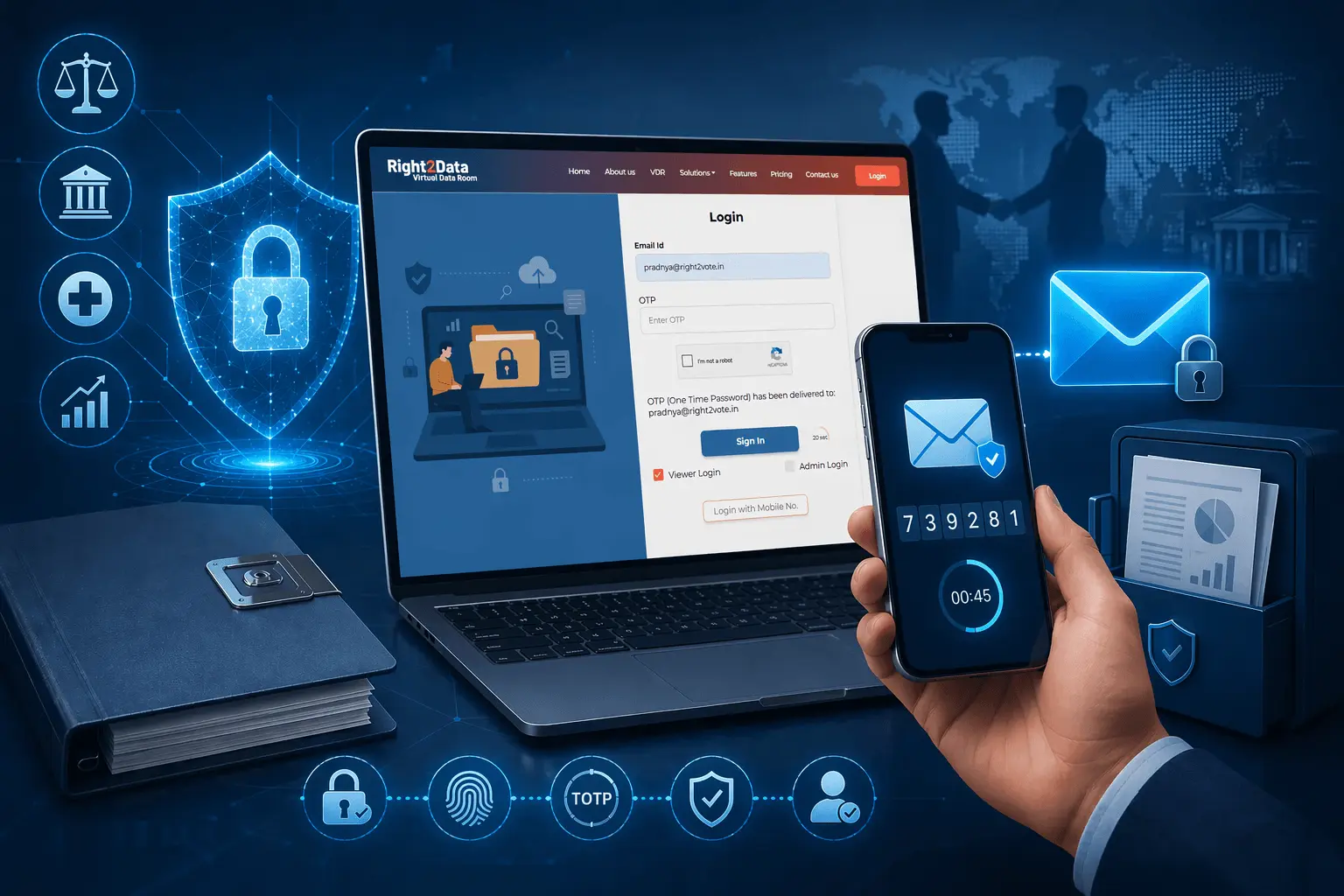
Right2Data’s Virtual Data Room (eDataroom) integrates OTP authentication as a critical multi-factor security layer to ensure that only authorized users with the correct email address can access sensitive documents. Instead of relying solely on traditional passwords, the system generates time-sensitive, one-time-use codes delivered securely via email.
Unlike static, confusing, and lengthy passwords that can be reused or stolen, OTP codes are valid for a short duration and expire, significantly reducing the risk of unauthorized access. This security mechanism became widely adopted after major data breaches exposed weaknesses in traditional password-based authentication systems. Industries such as legal advisory, finance, healthcare, investment banking and fundraising now rely on OTP authentication to secure sensitive processes, including Mergers & Acquisitions (M&A), IPO preparations, due diligence and investor communications.
Right2Data’s OTP authentication system verifies every login request with an additional step, providing stronger identity verification before granting access to confidential data. The OTP layer adheres to bank-grade security protocols, similar to those used in digital banking systems, combining cryptographic TOTP algorithms, secure transmission channels and real-time identity verification.
TOTP Algorithm
The system generates unique authentication codes using cryptographic algorithms such as HMAC (Hash-based Message Authentication Code) combined with synchronized timestamps. Each code is generated dynamically and expires after 30 minutes, ensuring it cannot be reused.
Time Synchronization
Right2Datas authentication system synchronizes with high-precision time servers, ensuring accurate OTP generation and validation across different geographic regions. Even if an attacker intercepts an OTP code, it becomes invalid within seconds immediately, making it practically impossible to reuse.
Multi-Channel Delivery
To ensure reliability and reduce delivery failures, OTP codes are sent via multiple channels, such as encrypted email and SMS, enabling users to receive authentication codes quickly and securely.
Protection Against Credential Theft
OTP authentication prevents unauthorized access even if a password is compromised, as attackers cannot log in without the temporary verification code.
Phishing and Brute-Force Attack Mitigation
Time-sensitive authentication codes render phishing and brute-force password attacks ineffective.
Improved User Security
Since OTP codes expire quickly, users remain protected even if credentials are exposed
Reduced Password Dependency
Minimizes reliance on static passwords and reduces password reset requests.
OTP-Based Login (Right2Data)
-
✓
Uses a dynamic one-time password generated for every login attempt.
-
✓
OTPs are time-sensitive and expire quickly, making them useless if intercepted.
-
✓
Not vulnerable to brute-force attacks since each authentication code is unique and short-lived.
-
✓
No need to remember passwords, improving user convenience and reducing support requests.
-
✓
Even if an OTP is intercepted, it cannot be reused after expiration.
-
✓
Provides multi-factor authentication security, verifying user identity with a temporary code.
-
✓
Eliminates credential reuse risks because each login requires a new OTP.
-
✓
Automatic security through time-based codes, reducing manual password management.
Traditional Password Login
-
✕
Uses a static password that remains the same until the user changes it.
-
✕
Passwords can be reused, guessed, or stolen through phishing or data breaches.
-
✕
Vulnerable to brute-force attacks, where attackers repeatedly try different password combinations.
-
✕
Users must remember complex passwords, leading to frequent password resets.
-
✕
If a password is compromised, attackers can repeatedly access the account.
-
✕
Provides single-factor authentication, relying only on a password.
-
✕
Higher risk of credential stuffing attacks using leaked password databases.
-
✕
Often requires periodic password changes, creating friction for users.
The above reasons define OTP authentication for banking, financial platforms and enterprise-grade secure document-sharing environments.
Time-Based OTP (TOTP) Algorithms
Unique codes generated using synchronized timestamps and cryptographic hashing.
Secure Communication Channels
OTPs delivered through encrypted email and SMS gateways.
Short Expiry Window
Each OTP expires quickly to prevent reuse or interception.
Multi-Factor Authentication Layer
OTP works alongside existing credentials to enable 2FA.
Authentication Logging
All OTP authentication attempts are logged for compliance monitoring and audit readiness.
Case Study: Mumbai-Based Investment Advisory Firm
A Mumbai-based mid-market investment advisory firm was managing a confidential acquisition deal involving multiple strategic investors. During due diligence, external stakeholders, including financial advisors, legal teams and investors, needed controlled access to sensitive documents.
By deploying Right2Data Virtual Data Room’s OTP-based authentication, each login required a time-sensitive verification code, ensuring only verified individuals could access the Virtual Data Room. This eliminated password-sharing risks and created secure audit logs for compliance.
The firm completed its transaction while maintaining full confidentiality, preventing unauthorized access and building investor confidence in the security of the deal environment.
Digital Personal Data Protection Act, 2023 (DPDP Act)
Ensures only authenticated users have access to personal and confidential data.
ISO/IEC 27001 Information Security Management Standard
Aligns authentication, access control and audit mechanisms with international standards.
RBI Cybersecurity Guidelines for Financial Institutions
Meets the recommendations for multi-factor authentication for banking and financial data platforms.
IBBI (Insolvency and Bankruptcy Board of India) Processes
Supports secure access during CIRP due diligence and resolution proceedings.
By combining bank-grade TOTP protocols, encrypted delivery channels and secure logging, Right2Data ensures sensitive documents are protected while maintaining regulatory and legal compliance.
Ready to secure your sensitive documents?
Book a demo with us. We are happy to help.
Request a demo
Why OTP Authentication Makes Right2Data VDR More Secure
Traditional password-only authentication is no longer sufficient to protect sensitive business data. By implementing OTP-based multi-factor authentication (MFA), Right2Data VDR ensures that every user accessing the Virtual Data Room is verified in real time.
Combined with audit trails, encryption, access control and activity monitoring, OTP authentication creates a multi-layered, bank-grade security framework, making Right2Data one of the most secure and trusted Virtual Data Room platforms for due diligence, legal transactions and financial operations.