What is a Data Room for Due Diligence? Redefining Global M&A Success with Right2Data VDR in 2026

Introduction
The Global M&A landscape in 2026 has entered a new era of strategic transformation. After the record-breaking rebound of 2025, the market has fundamentally reshaped itself. Driven by artificial intelligence, geopolitical realignment and the universal adoption of Virtual Data Rooms (VDRs). The cross-border deals have completely reconceptualized M&A transactions, data due diligence and Secure data transactions.
As we navigate a world of heightened regulatory scrutiny, economic divergence and AI integration. The question is no longer if you should use a VDR, but how to master VDR due diligence to stay competitive. For businesses seeking seamless M&A due diligence, the answer lies in advanced platforms like Right2Data VDR, an indispensable tool for securing complex, multi-jurisdictional transactions in a volatile global economy.
What is the Full Form of VDR and Why Does It Matter in 2026?
The full form of VDR is Virtual Data Room. By 2026, the Virtual Data Room (VDR) has evolved from a static repository for document storage into a dynamic “Deal Operating System” that orchestrates the entire lifecycle of corporate transactions, from initial fundraising to post-merger integration. It is no longer just a tool for security; it is the strategic backbone of high-stakes dealmaking.
Global M&A Landscape in 2026 : A Market Transformation
After a “deal winter” in 2023-2024, the global M&A market experienced a historic rebound in 2025, with total transaction volume reaching $4.9 trillion, a 40% increase from the previous year. Looking ahead, the momentum is expected to continue, with 80% of M&A executives expecting activity to remain stable or increase further in 2026.
Goldman Sachs predicts a 15% increase in M&A deal volume in 2026 compared to the previous year. This growth is fueled by several key trends:
- AI Integration: 45% of executives used AI in M&A transactions in 2025, double the number from 2024, and this is set to become standard practice.
- Carve-Outs: As boards simplify portfolios under geopolitical pressures, corporate carve-outs are emerging as the dominant trend of 2026.
- Strategic Realignment: Companies are moving from “passive response” to “active reinvention,” using M&A to adapt to disruptive technologies and a post-globalization economy.
India’s Ascension: The World’s Fourth-Largest Economy
India has officially surpassed Japan to become the world’s fourth-largest economy in 2026. Real GDP grew by 8.2% in Q2 FY 2025 and 26, the fastest rate among major economies. With the IMF projecting 6.2% growth and Goldman Sachs forecasting a stronger 6.9%, India’s economic momentum is undeniable.
This rapid growth is fueling a surge in cross-border M&A activity. Cross-border transactions dominate India’s M&A landscape, accounting for almost 70% of total deal volumes. Inbound deals represent 47%, while outbound transactions have risen to 23%, marking a structural increase.
“India continues to remain among the top 10 M&A markets globally,” notes Sourav Mallik, MD and Deputy CEO of Kotak Investment Banking, underlining the country’s growing relevance in cross-border transactions.
The landmark EU-India Free Trade Agreement, signed in January 2026, is expected to eliminate tariffs on more than 90% of traded goods, further strengthening trade flows and deepening economic ties between India and Europe.
Defining “Data Room for Due Diligence” in 2026
So, what is a data room for due diligence?
Data room due diligence is the systematic process of reviewing, validating and analyzing a target company’s confidential documents within a secure virtual environment during a transaction. In 2026, this process will become more complex than ever. Almost three-quarters (73%) of M&A professionals expect the due diligence process to become more complex over the next 12-24 months, including 15% who expect it to become much more complex.
Unlike physical data rooms (where teams review paper documents in a single location), VDR due diligence allows global teams to access, query and audit thousands of documents in real-time, 24/7, without compromising security. This simultaneity is the defining economic breakthrough of the modern VDR, multiple bidder groups can review the same documents at the same time without knowing of each other’s presence, allowing sellers to run competitive auctions with tighter timelines, driving up deal value.
The Three Pillars of Right2Data VDR for Due Diligence:
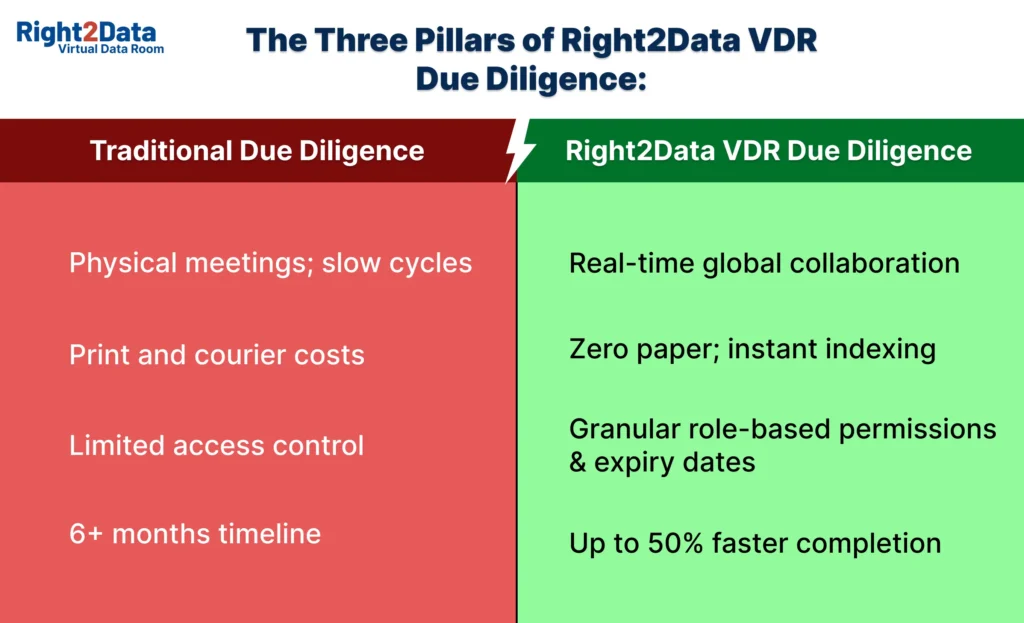
The Right2Data Advantage in M&A Due Diligence
In 2026, the M&A activity is solely driven by data security, regulatory compliance, ESG accountability and digital transformation. Forward-looking organizations see a VDR not just as a line-item cost but as a strategic investment that underpins risk management, speed and trust in critical projects. Here is how Right2Data transforms M&A due diligence:
1. Accelerated Timelines
Right2Data leverages a seamless experience, to cut due diligence cycles significantly. While traditional methods can take six months or more, Right2Data enables completion in as little as three months by automating document classification, redaction and summarization, enabling faster due diligence cycles while raising new questions about model governance and data residency.
2. Ironclad Security for Sensitive Information
With cybersecurity threats rising, Right2Data VDR offers encrypted data storage, dynamic watermarks, and granular role-based access controls. In M&A, insolvency proceedings and fundraising, not everyone should see everything, and that’s exactly where most data risks begin. Right2Data gives deal teams complete authority over who can view, download, print or share sensitive documents.
3. Automated Regulatory Compliance as the New Backbone
By 2026, Virtual Data Rooms have become the new compliance backbone for enterprises, helping meet frameworks such as ISO-27001, VAPT, IBBI, RBI and DPDA act. Right2Data VDR automates regulatory compliance tracking, flagging conflicts in data privacy laws before they derail a transaction. This is especially critical for cross-border deals that must navigate multiple regulatory jurisdictions simultaneously.
Regional Spotlights in 2026:
- Middle East: Saudi Arabia’s Vision 2030 reforms continue to attract unprecedented M&A activity, with sovereign wealth funds actively participating in technology, infrastructure and national champion strategies. Right2Data facilitates secure document exchange for energy and infrastructure project data with Asian and European partners.
- Japan: Japan’s M&A market has reached record highs, with transaction totals surpassing any previous quarter in early 2026. With Japanese companies hoarding a record $3.2 trillion in cash, outbound acquisitions are expected to maintain a fast pace. Japanese firms prioritize VDRs for transparency and to mitigate language-related barriers during post-merger integration.
- Europe: European deal flow in 2026 centers on technology, financial services, and industrial resilience. With 1,833 for-sale stories tracked in EMEA 15% up year-on-year, the demand for secure cross-border diligence platforms like Right2Data has never been higher.
The Asia Pacific region, driven by India’s economic surge and increasing cross-border M&A activities in 2026, is the fastest-growing market for VDR services.
Frequently Asked Questions on VDR Due Diligence in 2026
1. What is the difference between a normal cloud drive (Google Drive/SharePoint) and a Right2Data VDR for due diligence?
Standard cloud drives lack audit logs, dynamic watermarks, and “Q&A” modules. Right2Data VDR provides a compliance-grade environment where you can see who viewed which document, for how long, and automatically redact sensitive data. Once a file is emailed or downloaded from an FTP server, the seller loses all control over it. There is no way to prevent forwarding, printing, or saving to insecure drives. Right2Data VDR solves this by maintaining control throughout the entire transaction lifecycle. A document uploaded on a VDR cannot be modified and becomes a single point of truth.
2. How does Right2Data VDR support M&A due diligence in 2026?
Right2Data streamlines M&A due diligence by offering role-based access for buyers, sellers, and regulators. It supports bulk uploads, automatic indexing, and a secure Q&A feature that centralizes all queries between legal teams. With 73% of M&A professionals expecting due diligence to become more complex, having a dedicated VDR is no longer a luxury, it’s an essential tool for smooth and efficient deal execution.
3. Is Right2Data VDR suitable for small and mid-cap deals?
Absolutely. With mid-cap deals between Europe and China dominating the landscape 95% of such deals avoiding regulatory hurdles agile investors need cost-effective VDRs. Right2Data offers flexible pricing for small to mid-cap firms, ensuring that even deals under $50 million get enterprise-grade security. Right2Data has emerged as a frontrunner in the Indian VDR space, known for local compliance, better service and affordable pricing.
4. What does “Due Diligence” mean in the context of a VDR?
In a VDR context, due diligence refers to the investigative phase of a deal. Buyers use the VDR to review financial statements, contracts, IP registrations, and HR records. The VDR provides the “chain of custody” evidence required for legal sign-off. In several deals, there are multiple prospective buyers that are given time based sequential access with an exclusive look-in period for reviewing a potential buyout. Handling the documents securely, while ensuring exclusivity periods are kept sacrosanct are critical for any transaction. In 2026, due diligence has evolved to include AI-assisted document analysis, automated redaction and real-time compliance tracking.
5. How does Right2Data handle the surge in cross-border deals involving India?
Right2Data provides localized data residency options (keeping Indian data in India) while allowing seamless access for EU or US buyers. With cross-border deals accounting for nearly 70% of India’s M&A volume and the EU-India Free Trade Agreement now in effect, this dual compliance is critical for modern VDR due diligence.
Conclusion
As the worldwide M&A transaction volumes increase in 2026,the need for a specialized Right2Data VDR has never been greater. Whether you are a Japanese conglomerate acquiring US assets, a European fund investing in an Indian AI startup, or a Middle Eastern sovereign wealth fund diversifying its portfolio, mastering how to use a data room for due diligence will define your success in this new era of global M&A.
The market is moving faster than ever and speed is of essence. Don’t let outdated data rooms slow your next deal.
Choose Right2Data VDR for speed, security and success in 2026.
Table of Contents :
Important links :
Recent Blogs :
-
 Document Redaction: Manual vs AI Redaction in Virtual Data Rooms | Right2Data VDR
-
 VDR for Loan Syndication: How India’s Growing Debt Market Needs Better Data and Voting Infrastructure
-
 How Right2Data VDR Implements Secure Manual Document Redaction
-
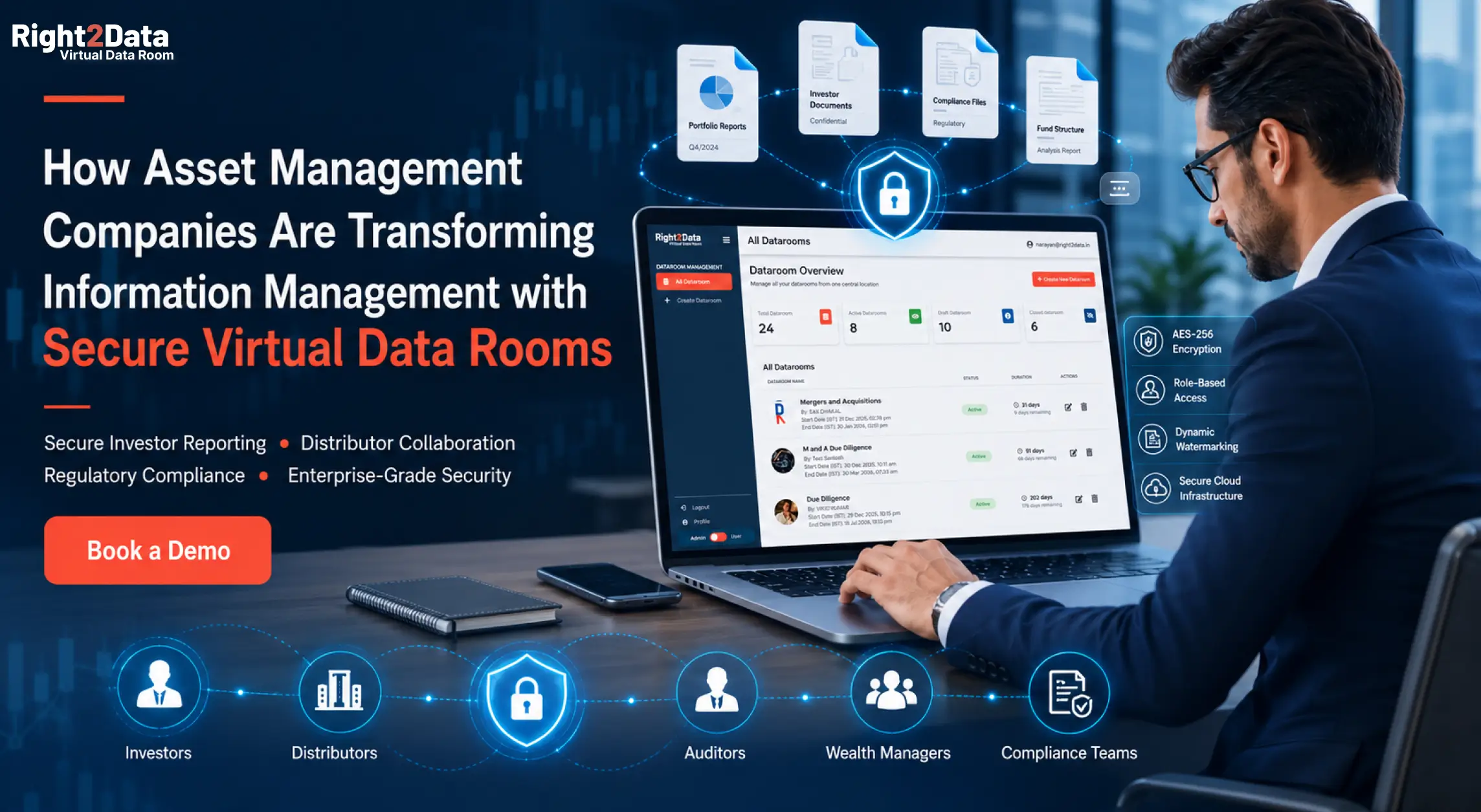 How Modern Asset Management Companies Are Transforming Information Management with Secure Virtual Data Rooms