VDR for Loan Syndication: How India’s Growing Debt Market Needs Better Data and Voting Infrastructure
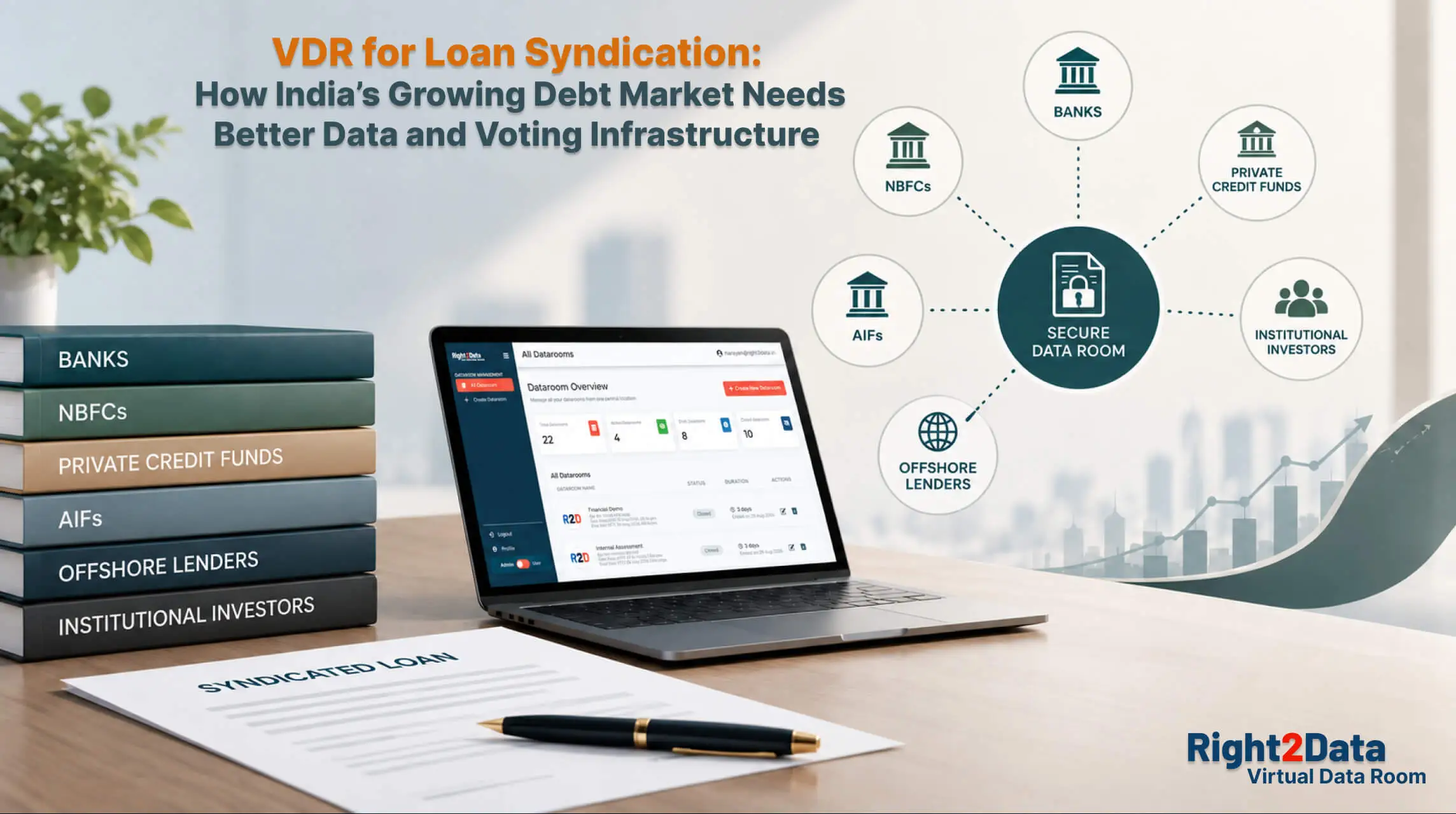
India’s corporate debt market is changing
For decades, large Indian borrowers have raised debt through bilateral bank facilities, consortium banking arrangements, project finance and overseas borrowings. Today, the combination of rising acquisition activity, private credit, overseas syndicated loans and a broader universe of lenders is creating a more complex multi-lender financing market.
The numbers are already meaningful.
Indian companies and financial institutions raised a record US$32.5 billion through overseas syndicated loans in 2025, compared with approximately US$26 billion in 2024. Sponsor financing, financial institutions, mid-market borrowers and acquisitions were important contributors.
At the same time, India’s private credit market deployed approximately US$12.4 billion across 166 transactions during 2025, representing 35% year-on-year growth in value. Refinancing, acquisition financing and capital expenditure were among the major uses of capital.
A further structural change came in 2026, when the RBI permitted eligible Indian banks to finance qualifying corporate acquisitions, with bank financing potentially extending to 75% of the acquisition value, subject to regulatory conditions.
India is still some distance from the highly liquid, broadly syndicated loan and CLO markets seen in the United States.
That creates a need not just for capital, but for better digital infrastructure around the debt transaction itself.
What is a syndicated loan?
A syndicated loan is a financing arrangement in which multiple lenders provide funding to a borrower under a common financing structure. A syndicated loan is financing provided by a group of lenders rather than a single institution.
Typically, one or more banks act as arrangers or lead lenders. They structure the facility, coordinate due diligence and bring other banks or financial institutions into the transaction.
Syndication is particularly useful when:
- The financing requirement is too large for one lender;
- Lenders want to diversify their exposure;
- The borrower wants multiple sources of capital;
- An acquisition needs a substantial financing package;
- A project requires lenders with different risk appetites
- Banks, NBFCs and private credit funds are participating in different parts of the capital structure.
India has had variants of this model for decades through consortium lending and project finance.
What is changing is the range of institutions providing capital and the sophistication of the financing structures.
Why India’s syndicated debt market could become much larger
The combination of private credit growth and the opening of acquisition financing to banks is particularly important.
Historically, acquisition financing in India often relied on combinations of promoter capital, NBFC financing, offshore loans, bonds and private credit.
The RBI’s 2026 acquisition-finance framework allows eligible banks to participate more directly in qualifying acquisitions, with bank funding capped at 75% of independently assessed acquisition value and the acquirer contributing the balance from its own funds.
That potentially brings a much larger group of balance sheets into acquisition financing.
Meanwhile, private credit has evolved beyond stressed or special-situation lending. EY’s 2025 data shows refinancing, acquisition finance and capex among the important uses of private-credit capital.
A future Indian financing could therefore involve some combination of:
commercial banks + NBFCs + private credit funds + AIFs + offshore lenders + institutional investors.
And the more lenders involved, the greater the coordination requirement.
A syndicated loan is ultimately an information-management exercise
Most discussion around syndicated lending focuses on pricing, interest rates, security, tenor and covenants.
Operationally, however, a syndication process depends heavily on information.
Before committing capital, lenders may need to understand:
- historical financial performance
- cash flows and financial projections
- existing borrowings
- security and collateral
- corporate structure
- promoter information
- contingent liabilities
- legal proceedings
- material contracts
- tax matters
- regulatory approvals
- the assumptions supporting future debt servicing.
For acquisition financing, lenders may additionally require extensive information about the target company and proposed transaction.
The challenge increases significantly when the same information has to be reviewed by five, ten or twenty institutions.
Why email and shared folders become difficult
A bilateral loan may sometimes be managed through conventional document sharing.
Multi-lender financing is different. An arranger may want certain documents available to all prospective lenders while restricting more sensitive information to institutions that have progressed further in their credit process.
- Different lenders may enter the process at different times.
- An updated financial model may replace the previous version.
- Potential lenders may withdraw and need their access revoked immediately.
- Some documents may be view-only while others may be downloadable.
And throughout the process, the borrower and arranger may want to know precisely who received access to what information, with a detailed audit trail.
This is where a Virtual Data Room or VDR becomes useful.
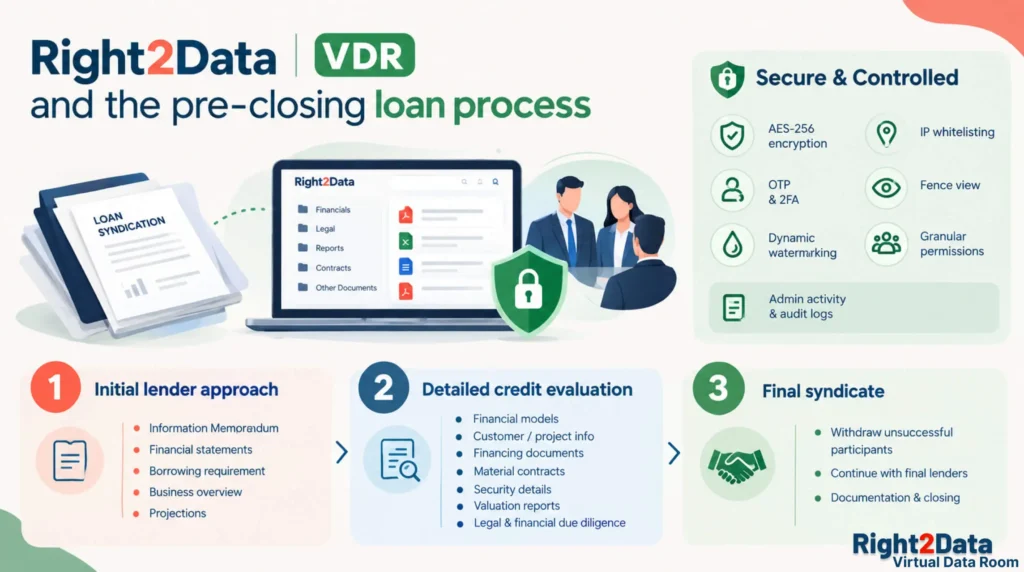
Right2Data VDR and the pre-closing loan process
A transaction-oriented VDR gives the borrower or arranger a controlled environment in which lender diligence can take place.
Right2Data’s Banking & Loan Syndication solution includes features such as AES-256 encryption, OTP authentication, two-factor authentication, dynamic watermarking, IP whitelisting, fence view, granular permissions, Admin activity and audit logs.
Learn more about Right2Data VDR security and document-management features, including OTP authentication, audit trails, view-only access, dynamic watermarking and granular permissions.
Instead of maintaining separate email threads and folders for each potential lender, the arranger can establish one structured data room with detailed reports available at any time.
For example:
Stage 1 – Initial lender approach
Potential lenders may receive:
- Information Memorandum;
- historical financial statements;
- borrowing requirement;
- business overview; and
- headline projections.
Stage 2 – Detailed credit evaluation
Selected lenders may then receive:
- detailed financial models;
- customer or project information;
- existing financing documents;
- material contracts;
- security details;
- valuation reports; and
- legal and financial due diligence.
Stage 3 – Final syndicate
Once lenders are selected, unsuccessful participants can have their access withdrawn while final lenders continue to documentation and closing, which is conceptually similar to a sell-side M&A data room.
The difference is that the counterparties evaluating the information are credit providers rather than potential equity buyers.
But closing the loan is not the end of the coordination problem
This is where syndicated lending differs from many other corporate transactions.
A loan may remain outstanding for five, seven, or even ten years. During that period, circumstances change. A borrower may want to undertake an action that was not contemplated when the financing was originally negotiated.
Financial performance may temporarily move outside agreed parameters.
- An acquisition opportunity may arise.
- A subsidiary may need to incur additional borrowing.
- An asset may need to be sold.
- The borrower may want to amend a financial covenant.
- Or a broader restructuring may become necessary.
- In a bilateral loan, the borrower negotiates with one lender.
In a syndicated loan, the finance documents generally specify which decisions can be approved by a Majority Lender group, Super Majority or all lenders.
The threshold depends entirely on the particular financing agreement.
That creates a second digital requirement: not just sharing information with lenders, but obtaining and recording lender decisions.
When do lenders need to vote or provide consent?
The precise requirements are governed by the facility agreement, intercreditor agreement and other finance documents.
But lender approval commonly becomes relevant in situations such as:
1. Covenant waivers
Suppose a borrower agrees to maintain a maximum Net Debt/EBITDA ratio of 3.5x.
Because of a temporary earnings decline, the ratio increases to 3.8x.
The borrower may request that lenders waive the breach for one testing period rather than allow it to constitute an Event of Default.
Depending on the financial documents, this may require consent from lenders representing a specified percentage of the facility.
2. Covenant amendments or resets
Sometimes the issue is not a one-time waiver.
The borrower may request that:
- Net Debt / EBITDA ≤ 3.5x be amended to:
- Net Debt / EBITDA ≤ 4.0x for the next four quarters.
This is effectively a negotiation between the borrower and the lending syndicate.
3. Waiver of an Event of Default
A default may have technically occurred, but lenders may decide that enforcement is not the commercially sensible response.
Loan agreements commonly allow specified majorities of lenders to waive certain defaults, while more fundamental changes require broader consent.
Syndicated facility agreements frequently differentiate between matters that a Majority Lender group can approve and fundamental changes requiring all lenders.
4. Additional borrowing
A borrower may seek permission to:
- raise another working-capital facility;
- issue additional debt;
- obtain acquisition financing; or
- Permit a subsidiary to borrow.
If the existing loan documents restrict incremental indebtedness, lender consent may be required.
5. Acquisitions and investments
A borrower may want to acquire another business.
Existing financing documents may limit acquisitions or investments unless certain financial conditions are met.
Where an acquisition falls outside the permitted baskets contained in the facility agreement, lenders may need to approve it.
6. Asset sales
The borrower may want to sell:
- a factory;
- a subsidiary;
- real estate;
- intellectual property; or
- another material asset.
If that asset forms part of the lender security package or the disposal exceeds limits permitted by the loan agreement, lender approval may be required.
7. Release or substitution of security
If secured assets are being sold, refinanced or replaced, lenders may need to decide whether security can be released or substituted.
Material releases of collateral frequently attract higher consent thresholds than ordinary amendments.
8. Extension of maturity or repayment dates
A borrower facing a temporary liquidity issue may seek an extension in repayment dates.
Changes to principal repayment, maturity, interest, or other fundamental economic terms frequently require very high consent thresholds and, in many syndicated agreements, require consent of all affected lenders or all lenders.
9. Changes in pricing
A borrower may request:
- a reduction in interest margin;
- revision of fees;
- changes in default interest; or
- Another alteration to the economics of the facility.
These are usually treated differently from ordinary covenant waivers because they directly affect lender economics.
10. Enforcement decisions
After an Event of Default, lenders may need to decide whether to:
- accelerate the loan;
- enforce security;
- appoint advisers;
- commence restructuring discussions; or
- Pursue another recovery strategy.
The security trustee or facility agent may ultimately act on instructions received from the requisite lender group.
11. Restructuring proposals
Where a borrower experiences financial stress, lenders may have to evaluate competing restructuring options involving:
- extension of tenor;
- moratoriums;
- changes in interest;
- additional funding;
- debt-to-equity conversion;
- security changes; or
- revised repayment schedules.
At this stage, lender coordination can become as important as lender analysis.
From lender consent to structured electronic voting
Traditionally, obtaining consent from multiple banks may involve meetings, emails, letters, scanned approvals and extensive follow-up by the facility agent that can work, but it creates an administrative problem:
Q. Who was entitled to vote?
Q. What was their voting weight?
Q. What exactly were they voting on?
Q. When did they vote?
Q. Was the required threshold achieved?
Q. Is there a reliable record?
This is where an electronic voting system can complement the VDR.
Right2Vote as the decision layer for a syndicated loan
Right2Vote is an electronic voting platform developed by the same company behind Right2Data.
Its corporate-voting solution specifically supports creditor voting and includes capabilities such as weighted votes, audit trails, voter authentication, reminders and voter receipts.
Weighted voting is particularly relevant for syndicated lending.
Consider a ₹1,000 crore facility:
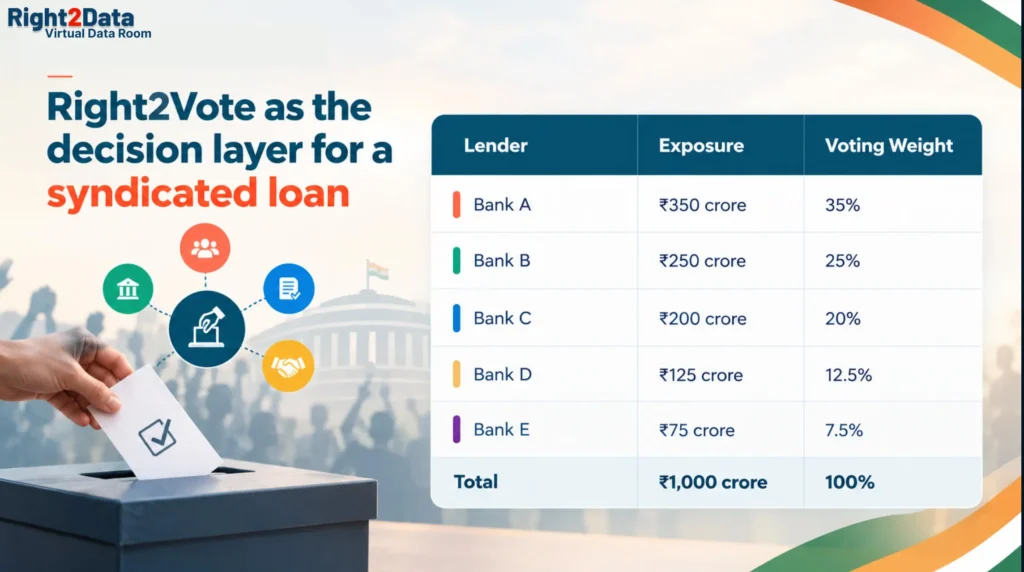
If the facility agreement defines Majority Lenders as lenders representing more than, say, 66% of commitments, the voting process needs to measure economic exposure rather than simply count institutions.
The actual threshold must always come from the finance documents.
Right2Vote’s weighted-voting capability allows different voting weights to be assigned to different participants, while Right2Vote’s audit trail records participation and voting activity.
That makes it potentially useful for obtaining structured lender responses to resolutions such as:
“Approve / Reject / Abstain: waiver of the Net Debt/EBITDA covenant for the quarter ending 31 March.”
Or
“Approve / Reject / Abstain: proposed acquisition of XYZ Limited pursuant to Clause 22.4 of the Facility Agreement.”
Right2Data + Right2Vote: two digital layers of the same financing
Taken together, the two platforms can address different parts of the syndicated-loan lifecycle.
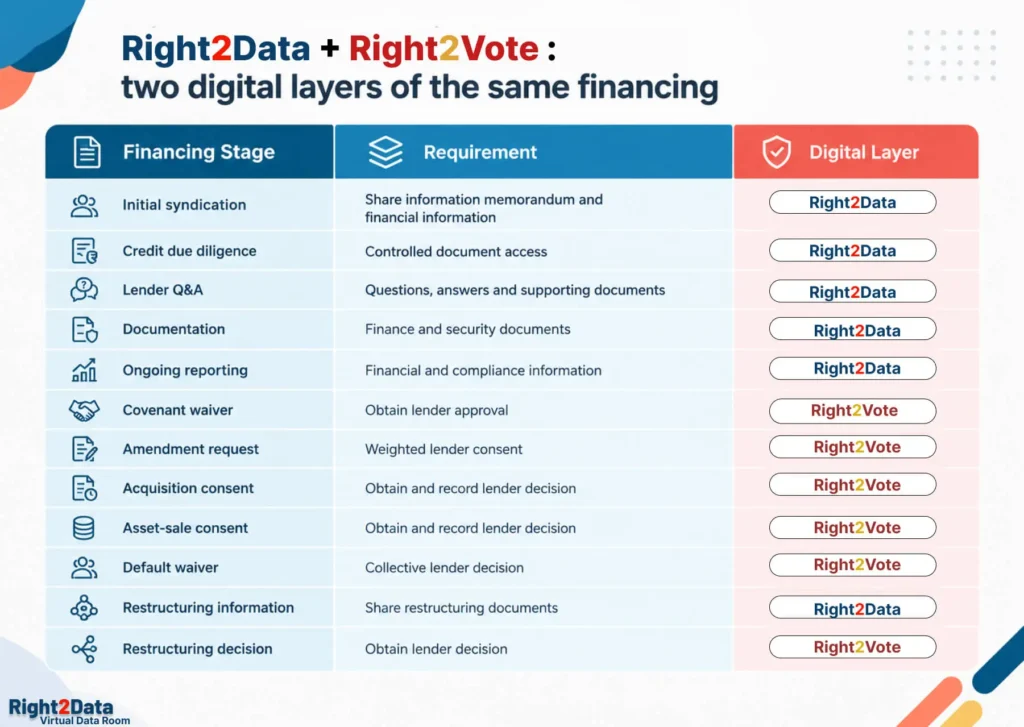
This creates a much more interesting proposition than viewing a VDR as merely a repository used while the loan is being raised.
Right2Data manages the information layer. Right2Votemanages the decision layer.
The model already exists in India’s insolvency ecosystem
There is an interesting precedent.
Under India’s insolvency framework, creditors routinely need both information and formal decision-making infrastructure.
Right2Vote already provides weighted electronic voting for Committee of Creditors processes under the Insolvency and Bankruptcy Code, including vote-share-based results, OTP authentication, audit trails and voter receipts.
Right2Data is also used for controlled information sharing in insolvency and restructuring processes.
The syndicated-loan opportunity applies a similar concept earlier in the credit lifecycle:
Data → diligence → loan → monitoring → consent → amendment → restructuring, if required.
Instead of implementing separate disconnected systems at each stage, lenders, borrowers and advisers can increasingly digitise the entire process.
Why this matters even more as syndicates become larger
Consider a five-bank consortium.
A borrower requests permission for an acquisition.
The borrower first needs to provide:
- acquisition rationale;
- transaction documents;
- target financial statements;
- valuation;
- pro-forma leverage;
- financing structure; and
- revised cash-flow projections.
Those documents can be provided through Right2Data.
Banks analyse the proposal.
The facility agent then circulates a formal resolution.
Each lender casts its weighted response through Right2Vote.
The voting platform calculates whether the required contractual threshold has been reached.
The lawyers and facility agent then execute the necessary consent or amendment documentation.
The entire process creates a much clearer audit trail than a collection of documents, phone calls and email approvals spread across several organisations.
The opportunity for debt advisors and arrangers
This infrastructure is potentially useful not only for borrowers and banks.
Investment banks, debt advisors, merchant banks and independent debt arrangers increasingly manage competitive financing processes. Instead of approaching ten different lenders independently with ten sets of attachments, an arranger could establish a controlled lender data room.
During the life of the facility, the same digital workflow could support:
- information dissemination;
- lender meetings;
- covenant requests;
- amendments;
- voting;
- refinancing; and
- restructuring.
This turns transaction technology into part of the arranger’s service offering.
India does not need to replicate the US market to need this infrastructure
India’s loan market remains structurally different from the US broadly syndicated loan market.
The US has a very large institutional investor base, CLO ecosystem and active secondary loan market, whereas India continues to be much more relationship-bank oriented.
But a liquid secondary market is not a prerequisite for better syndication infrastructure.
The important variables are simply:
- Number of lenders × volume of information × frequency of decisions × sensitivity of information.
All four are likely to increase as India’s corporate credit market becomes deeper.
A digital operating system for syndicated debt
The next stage in India’s debt-market evolution will not only be about who provides capital. It will also be about how transactions are executed. A modern syndicated loan can involve dozens of participants and thousands of documents over several years.
The technology supporting it therefore needs to solve two very different problems.
Q. Who should have access to which information?
That is the role of a secure Virtual Data Room such as Right2Data.
Q. When lenders need to make a collective decision, who is entitled to vote, what is their voting weight, what did they decide and was the required threshold achieved?
That is where an electronic voting platform such as Right2Vote can fit.
Together, they provide infrastructure across the lifecycle of the financing from lender diligence and syndication through covenant management, amendments and, where necessary, restructuring.
As India’s syndicated-loan, acquisition-finance and private-credit markets expand, the opportunity is not merely to digitise document sharing.
It is to digitise the relationship between borrowers, arrangers and lenders throughout the life of the loan.
Frequently asked questions
1. What is a syndicated loan?
A syndicated loan is financing provided by multiple lenders under a common financing structure, typically coordinated by one or more arrangers or facility agents.
2. How large is India’s syndicated loan market?
Indian borrowers raised approximately US$32.5 billion through overseas syndicated loans in 2025 alone. Domestic consortium and multi-bank lending constitute an additional market but are not directly comparable with US-style broadly syndicated loans.
3. Is private credit growing in India?
Yes. EY reported approximately US$12.4 billion of Indian private-credit investment across 166 transactions in 2025, representing 35% annual growth by value.
4. Why use a VDR for loan syndication?
A VDR allows borrowers and arrangers to centrally distribute confidential documents while controlling which lenders can view or download particular information and maintaining an audit trail.
5. Why would lenders need to vote after a syndicated loan has closed?
During the life of a loan, borrowers may request covenant waivers, amendments, approval for acquisitions or additional borrowing, security releases, restructuring or other actions requiring consent under the facility documents.
6. Does every lender have one vote?
Not necessarily. Syndicated-loan decisions are generally governed by contractual voting thresholds and may be calculated according to commitments or exposures. The precise methodology is determined by the financing documents.
7. Can Right2Vote replace an amendment agreement?
No. Right2Vote can provide a structured mechanism to obtain, calculate and record lender decisions. Any amendment, waiver or consent must still satisfy the execution and documentation requirements contained in the applicable finance documents.
8. Can Right2Data and Right2Vote be used together?
Yes. Right2Data can manage confidential lender information and due diligence, while Right2Vote can provide the electronic voting layer when participating lenders need to make collective decisions.
9. Can the same platforms be used during restructuring?
Potentially, yes. Right2Data can be used to distribute restructuring proposals and supporting information, while Right2Vote can be used to collect weighted creditor decisions where appropriate. Right2Vote already supports creditor voting in Indian insolvency proceedings.
Choose Right2Data VDR for speed, security and success in 2026. India’s Most Affordable Virtual Data Room for Mergers, Acquisitions, Due Diligence, IPOs and Beyond.
Table of Contents :
Important links :
Recent Blogs :
-
VDR for Loan Syndication: How India’s Growing Debt Market Needs Better Data and Voting Infrastructure
-
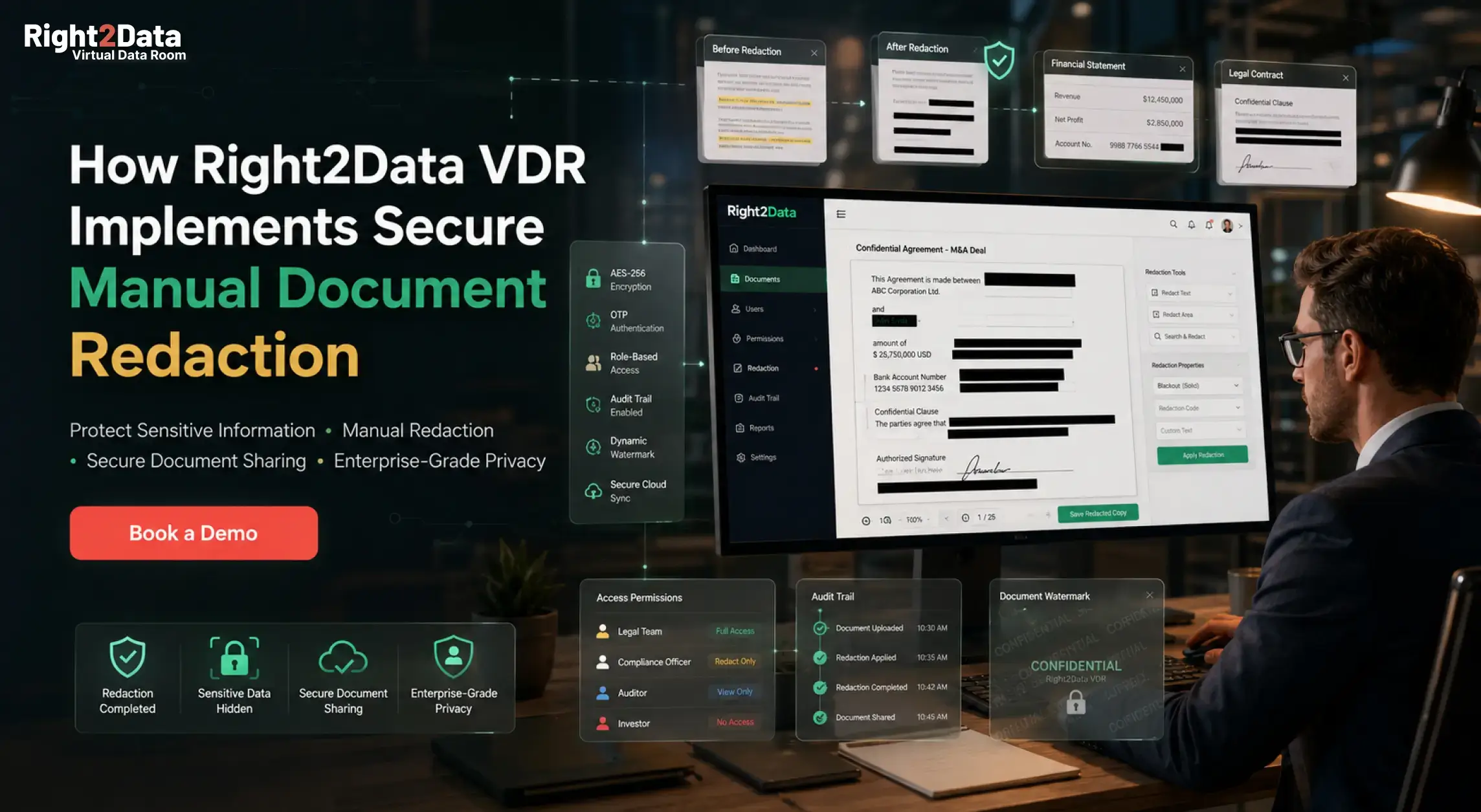 How Right2Data VDR Implements Secure Manual Document Redaction
-
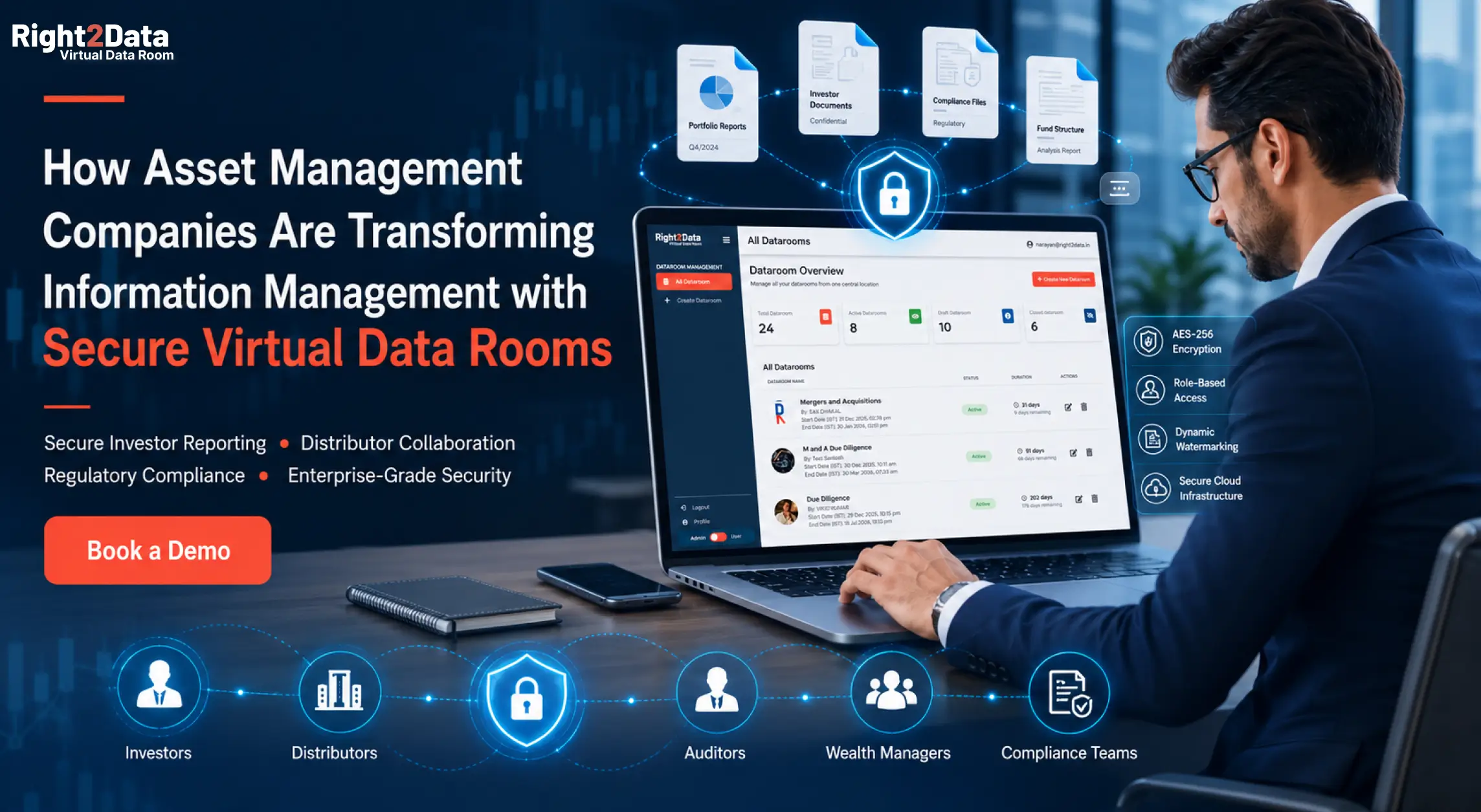 How Modern Asset Management Companies Are Transforming Information Management with Secure Virtual Data Rooms
-
 Startup Fundraising in 2026: Why Virtual Data Rooms (VDRs) Are Essential for Venture Capital Due Diligence