Virtual Data Room for Pharma (Pharmaceutical Companies) | Right2Data VDR
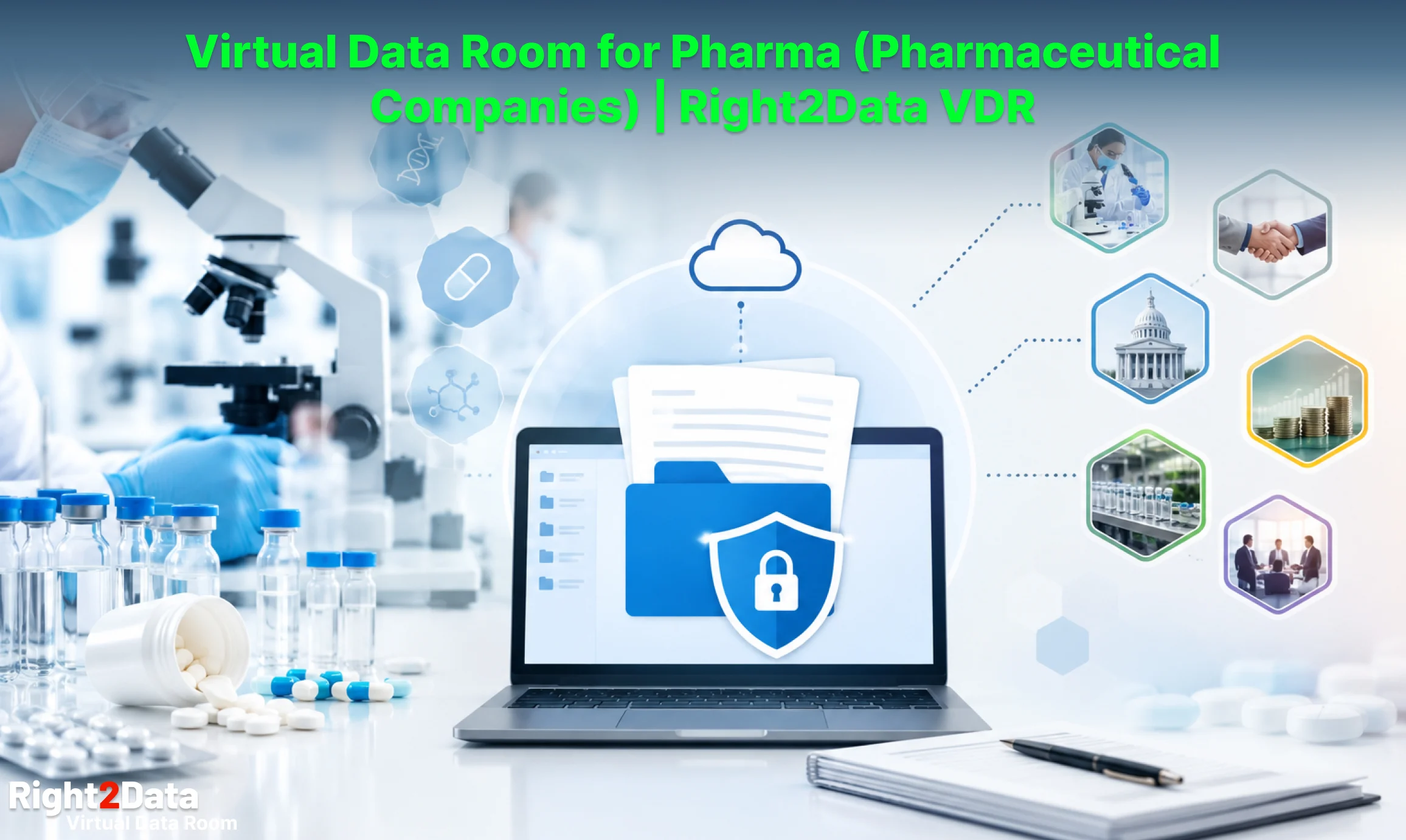
Pharmaceutical companies constantly innovate to develop the next breakthrough drug or reduce costs and they manage some of the world’s most sensitive business information. Beyond laboratory research, proper documentation and document management at every stage are critical to success. From drug development records and clinical research documentation to manufacturing processes, quality reports, patents and licensing agreements, every stage of the pharmaceutical lifecycle involves information that must be handled carefully.
As pharmaceutical businesses collaborate with research organisations, contract manufacturing organisations (CMOs), contract research organisations (CROs), regulators, investors, distributors and strategic partners, sharing documents securely becomes increasingly important. Email attachments and ordinary cloud folders may not provide the level of access control, accountability and document governance required for sensitive business transactions.
A virtual data room for pharmaceutical companies provides a centralised environment for sharing confidential documents with authorised stakeholders. With controlled access, activity tracking, document protection and structured collaboration, a virtual data room (VDR) can support pharmaceutical companies during research partnerships, licensing discussions, regulatory reviews, manufacturing assessments, fundraising and mergers and acquisitions.
For pharmaceutical businesses operating in India and international markets, the right VDR can help organise critical information while maintaining greater control over how documents are accessed and shared.
For a broader overview of how Virtual Data Rooms support the sector, explore our guide to Virtual Data Rooms in Life Sciences, Biotechnology and Pharmaceutical Companies.
What Is a Virtual Data Room for Pharmaceutical Companies?
A virtual data room for pharmaceutical companies is a secure online platform used to store, organise and share confidential pharmaceutical business documents with approved users.
Unlike a basic file-sharing service, a purpose-built VDR offers features designed for sensitive business workflows. Administrators can organise documents into folders, assign access permissions, monitor user activity and manage information shared with different external parties.
Pharmaceutical companies can use a VDR to manage documents relating to:
- Drug discovery, research and development
- Clinical research and trial documentation
- Patents, intellectual property and proprietary formulations
- Manufacturing processes and technology transfer
- Regulatory submissions and supporting records
- Licensing, partnerships and distribution agreements
- Fundraising, investment due diligence and acquisitions
A VDR does not replace a pharmaceutical company’s validated clinical systems, electronic trial management platforms, quality management systems or regulatory obligations. Instead, it can serve as a controlled document-sharing environment for approved information exchanged during specific projects and business processes with external collaborators.
Why Pharmaceutical Companies Need Secure Document Sharing
Pharmaceutical information has commercial, scientific, contractual and sometimes personal significance. Unauthorised disclosure of a formulation, patent strategy, manufacturing procedure or clinical research document may create financial, legal or reputational risks.
At the same time, pharmaceutical companies cannot operate in isolation. Research partners need information to evaluate projects, investors need supporting records before making funding decisions and prospective licensees need sufficient documentation to assess a product or technology.
A virtual data room helps balance these competing needs by allowing organisations to share information without automatically giving every participant the same level of access.
1. Protecting pharmaceutical intellectual property
Drug formulations, research findings, patent documents, manufacturing methods and proprietary technologies can represent years of investment.
When pharmaceutical companies share these materials with external partners, they need to consider what information is disclosed, who can access it and whether further distribution is permitted.
A VDR can help protect confidential information through user permissions, view-only access where supported, dynamic watermarking, activity tracking and other document protection features.
For example, a pharmaceutical company exploring a licensing agreement may provide a prospective partner with selected research reports and approved technical documentation. More sensitive commercial or manufacturing information can remain restricted until the appropriate stage of negotiations.
These controls help reduce exposure, although they cannot eliminate every risk of copying, photographing or disclosing information.
2. Managing research and clinical documentation
Pharmaceutical development generates extensive documentation throughout preclinical research, clinical development, analysis and project evaluation.
Different stakeholders may need access to different categories of records. A research partner may need approved study documents, while a prospective investor may require selected summaries and development milestones.
A VDR can help organise approved documents by project, study, document category or review stage. Permissions can then be assigned to authorised users according to their responsibilities.
However, clinical data containing personal or sensitive information requires appropriate safeguards. A general-purpose VDR should not automatically be treated as a validated clinical data management system or as a substitute for applicable privacy, research ethics and regulatory requirements.
3. Supporting regulatory and quality reviews
Pharmaceutical businesses maintain extensive records related to quality assurance, manufacturing, validation, standard operating procedures (SOPs), supplier qualification and regulatory activities.
When an authorised auditor, business partner or prospective acquirer requests supporting documents, locating the correct version quickly can be challenging if records are dispersed across teams and storage locations.
A structured data room can provide a controlled location for sharing approved copies of relevant records. Access permissions and activity logs can also help administrators review how shared documents are being accessed.
Key Uses of Virtual Data Rooms in the Pharmaceutical Industry
The value of a pharmaceutical VDR extends beyond storing research files. It can support several business activities where confidential information must be exchanged with multiple stakeholders.
-
Pharmaceutical licensing and technology transfer
Licensing arrangements allow pharmaceutical companies to commercialise products, access new technologies or expand into additional markets. Technology transfer may involve the exchange of approved technical information, manufacturing documentation, quality requirements and contractual materials.
A VDR helps organise the documents that authorised parties need to review during negotiations and transfer planning.
For instance, a pharmaceutical manufacturer evaluating a licensing opportunity may create separate folders for intellectual property, product information, manufacturing documentation, quality records and commercial terms. Legal, technical and commercial reviewers can receive access appropriate to their roles.
This structure helps the parties manage disclosure and maintain a clearer record of shared information.
-
Contract research and manufacturing partnerships
Pharmaceutical companies frequently collaborate with CROs and CMOs to conduct research, support clinical development, manufacture products or manage specialised activities.
These relationships may involve confidentiality agreements, technical specifications, quality documentation, project reports, supplier assessments and commercial contracts.
A VDR can provide a central location for approved documents shared with the relevant partner. Administrators can organise records by project and manage access as responsibilities change.
Before sharing information, companies should confirm that the selected platform, contractual arrangements and data-handling procedures meet the requirements of the specific project.
-
Pharmaceutical mergers and acquisitions
Mergers, acquisitions, asset purchases and strategic investments require extensive due diligence. A buyer may need to review financial statements, intellectual property portfolios, licensing agreements, manufacturing capabilities, product pipelines, quality records and material contracts.
A pharmaceutical VDR helps the seller organise this information and provide controlled access to prospective buyers and their advisors.
For example, a company preparing to sell a product portfolio may organise the room into corporate records, financial information, product documentation, intellectual property, manufacturing, regulatory materials and commercial agreements.
A structured data room helps reviewers locate information while enabling the seller to manage permissions and monitor document activity throughout the transaction.
To understand how secure document sharing supports transaction reviews, read our guide to Due Diligence Using a Virtual Data Room (VDR) in India.
-
Fundraising and investor due diligence
Pharmaceutical startups and established businesses may seek funding to advance product development, expand manufacturing capacity or enter new markets.
Investors often need evidence supporting the company’s commercial opportunity, financial position, intellectual property strategy, development milestones and business risks.
A VDR helps the company present relevant information in an organised environment. It also allows the team to control which investors can access particular materials.
Preparing the room before fundraising begins can reduce repeated document requests and help management respond to investor questions more systematically.
-
Manufacturing quality assessments and supplier reviews
Manufacturing partnerships and supplier assessments can require the exchange of approved quality manuals, audit reports, validation records, equipment documentation and supplier qualification materials.
A VDR can support the controlled sharing of these records with authorised reviewers.
The company should maintain its official quality records in the appropriate quality management or document control system. The VDR can be used to share approved copies for a particular review without replacing the formal recordkeeping process.
Essential Features to Look for in a Pharmaceutical VDR
Not every virtual data room is suitable for every pharmaceutical workflow. Before choosing a platform, companies should evaluate the sensitivity of their documents, the roles of external participants and any relevant regulatory or contractual requirements.
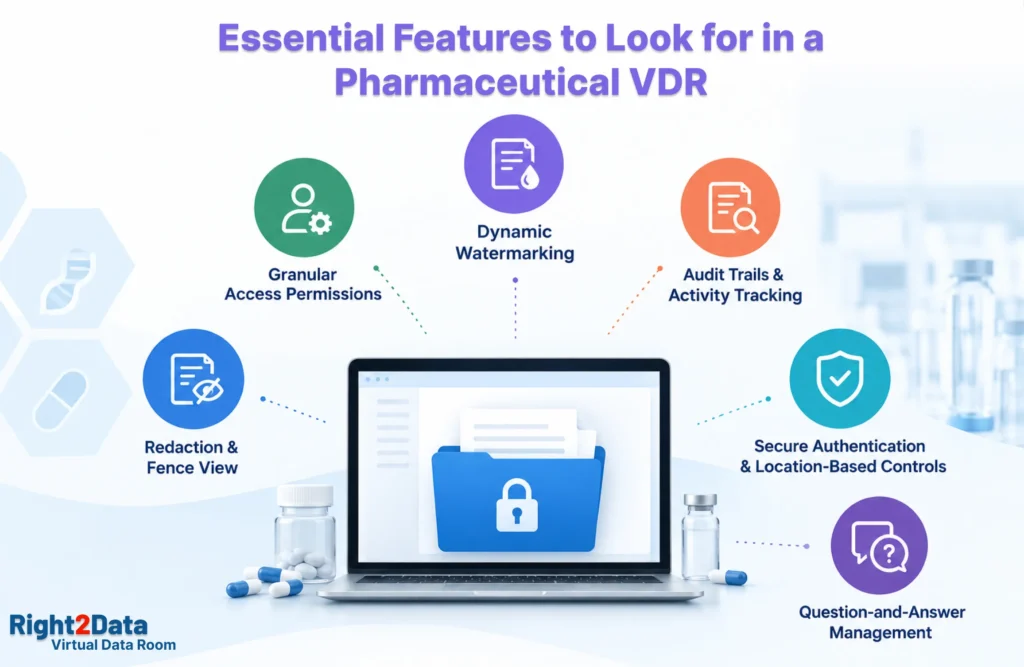
I. Granular access permissions
A pharmaceutical company may work with scientists, legal advisors, investors, manufacturing partners, auditors and distributors at the same time.
Granular permissions help administrators determine which users can access particular folders or documents. Depending on the platform, permissions may also control viewing, printing and downloading.
This is particularly useful when sharing selected information with a prospective licensee or buyer without exposing unrelated research or commercial records.
II. Dynamic watermarking
Dynamic watermarking places identifying information on documents viewed through a supported workflow. Depending on the configuration, the watermark may contain details such as the user’s name, email address or access information.
For pharmaceutical companies, this can discourage unauthorised redistribution of proprietary research, technical documents, financial records and confidential agreements.
Watermarking is a deterrent and accountability measure, not a guarantee that information cannot be copied or disclosed.
III. Audit trails and activity tracking
Audit trails record relevant activity within a data room, depending on the platform’s capabilities and configuration.
Administrators may be able to review document access, user activity, timestamps and other recorded actions. These records can help teams investigate access questions and maintain visibility during licensing, due diligence and partnership reviews.
A VDR’s audit trail should not be confused with a complete regulatory audit system or proof that a pharmaceutical process itself meets applicable requirements.
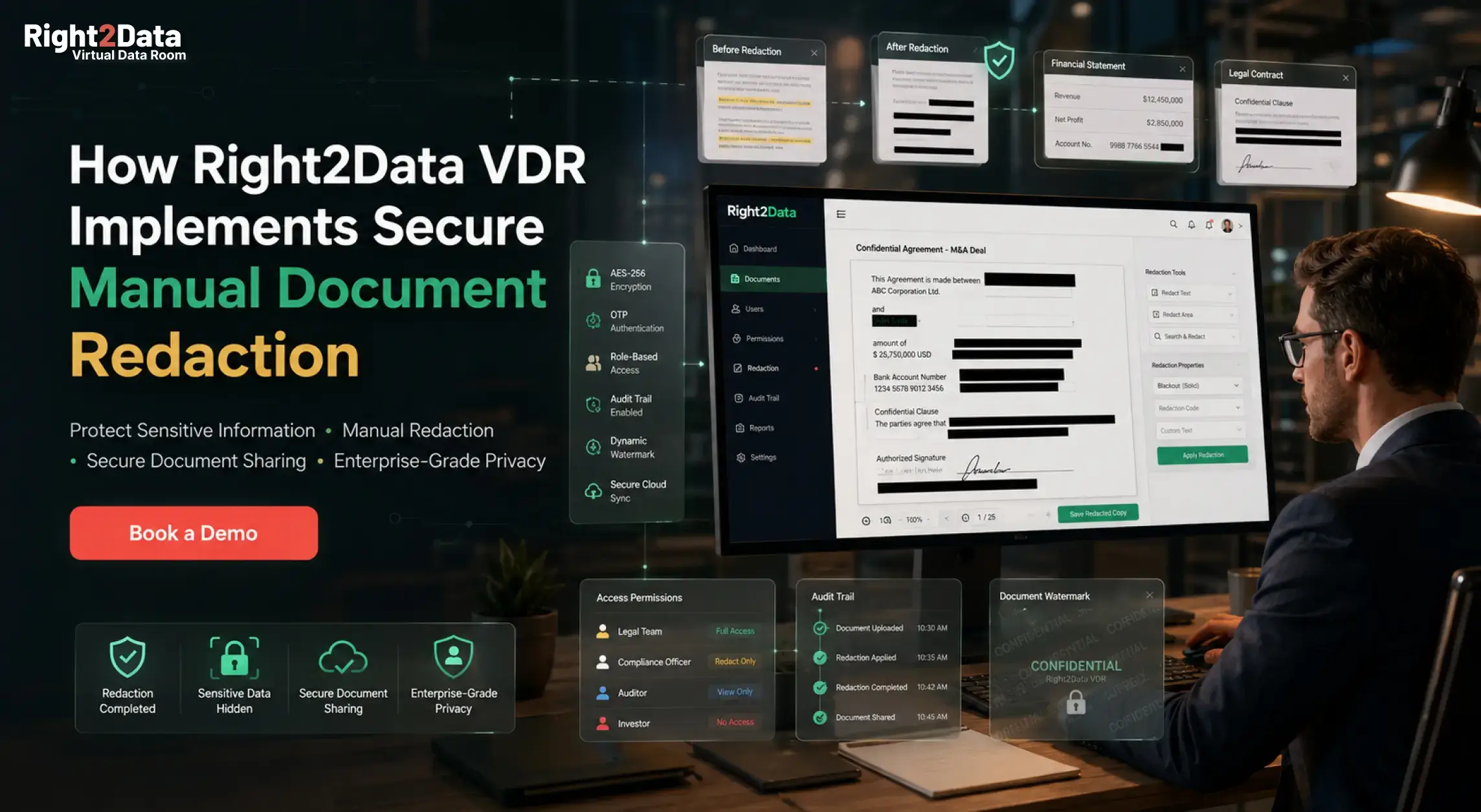
IV. Redaction and Fence View
Before sharing documents externally, pharmaceutical companies may need to conceal information that is irrelevant to a particular reviewer or that should not be disclosed.
Redaction can permanently remove selected sensitive content from a prepared document when implemented correctly. Teams should verify the redacted version before making it available.
Fence View, where available, limits the portion of a document visible at one time. It can reduce certain copying risks during document review, although it cannot prevent every method of capturing information.
Before sharing confidential research, formulations or intellectual property documents, organisations can also benefit from secure manual document redaction to conceal sensitive information.
V. Secure authentication and location-based controls
Authentication helps confirm that access is being requested through an authorised account or verification process.
Depending on the provider and selected plan, a VDR may offer one-time passwords (OTP), two-factor authentication, viewer verification, IP restrictions, geo-tagging or geo-fencing.
Pharmaceutical companies should select controls appropriate to their risk profile and consider whether external partners can access the room reliably from their approved locations.
VI. Question & Answer management
During due diligence or a technical review, participants may raise questions about manufacturing capacity, product development, licensing terms, quality documentation or financial information.
A built-in Q&A module can centralise these questions and responses instead of scattering them across email threads. Administrators can coordinate responses and maintain a clearer record of the review process.
Access to questions and answers should also be controlled so that confidential responses are not inadvertently shared with unrelated participants.
How Right2Data VDR Supports Pharmaceutical Companies
Right2Data provides a virtual data room platform for confidential document management, secure sharing and transaction-related collaboration. Its published solutions include biotechnology and life sciences workflows, which overlap with several document-management needs of pharmaceutical businesses.
Relevant capabilities described by Right2Data include:
- OTP authentication: Adds a verification step when users access the data room.
- Multiple administrators: Supports shared administration through designated roles.
- Document permissions: Allows administrators to control supported viewing, printing and downloading rights.
- Audit trails and activity tracking: Records relevant user activity for administrative review.
- Dynamic watermarking: Adds identifying information to documents to discourage unauthorised sharing.
- Fence View: Limits the visible portion of a document in supported viewing workflows.
- Redaction: Helps administrators remove selected sensitive information before external disclosure.
- Q&A module: Centralises questions and responses during document review.
- Geo-tagging and geo-fencing: Provides location-related monitoring or access controls where enabled.
- AES-256 encryption: Uses the encryption standard described in Right2Data’s published security information.
Right2Data VDR‘s platform is ISO 27001 certified and VAPT-tested and its default hosting uses Microsoft Azure servers in Chennai, India. Pharmaceutical organisations should verify the scope of the relevant certifications, hosting arrangements, contractual terms and technical controls before relying on them for a particular project.
These features can support controlled document sharing, but they do not independently establish compliance with every pharmaceutical, clinical research, privacy or quality requirement.
To explore the available capabilities, visit the Right2Data VDR features page or review its biotechnology and life sciences solution.
How to Choose the Right Virtual Data Room for Your Pharmaceutical Business
Before selecting a VDR, pharmaceutical companies should assess the platform against the actual workflow it will support.
- Start with the intended use. A room for investor due diligence may have different requirements from one used to share manufacturing documentation or support a licensing transaction.
- Assess document security. Review authentication, access permissions, encryption, watermarking, redaction and activity records. Confirm which features are included in the chosen plan.
- Check data privacy and regulatory requirements. Identify whether documents contain personal information, clinical records, or other restricted data. Confirm the provider’s contractual and technical suitability for handling that information.
- Evaluate collaboration tools. Consider whether the platform supports the number of external participants, Q&A processes and administrative roles your team needs.
- Review usability and support. External partners should be able to access the room without unnecessary friction. Evaluate onboarding, training, and technical support arrangements.
- Compare the full cost. Review storage limits, user allowances, subscription periods, advanced features, additional charges and support before making a decision.
A short pilot using representative documents and test user accounts can help identify practical limitations before the data room is used for a live transaction.
Frequently Asked Questions
1. What is a virtual data room used for in the pharmaceutical industry?
Pharmaceutical companies use virtual data rooms to share confidential documents during licensing, research partnerships, manufacturing assessments, fundraising, regulatory reviews, due diligence and mergers and acquisitions.
2. How does a VDR protect pharmaceutical intellectual property?
A VDR can help protect intellectual property through controlled user permissions, authentication, dynamic watermarking, activity tracking and supported restrictions on printing or downloading. These measures reduce certain risks but cannot guarantee complete prevention of unauthorised disclosure.
3. Can pharmaceutical companies use a VDR for clinical trial documents?
Yes, for appropriate document-sharing workflows. However, companies must assess privacy, consent, security, validation and applicable clinical research requirements. A general-purpose VDR does not automatically replace a validated clinical trial management or clinical data management system. Most common document types, including Microsoft files, image types and drawing files, are supported.
4. Can a virtual data room help with pharmaceutical regulatory reviews?
A VDR can help organise and share approved supporting documents with authorised reviewers. It may improve access management and document visibility, but it does not itself guarantee regulatory compliance or replace formal quality and recordkeeping systems.
5. Is Right2Data suitable for pharmaceutical companies in India?
Right2Data publishes a biotechnology and life sciences solution with features for confidential document sharing, access management and activity tracking. Pharmaceutical companies should assess the platform’s current features, hosting, security documentation and contractual suitability against their specific needs.
Secure Pharmaceutical Collaboration Starts with Better Document Control
Pharmaceutical companies depend on collaboration to develop products, evaluate partnerships, expand manufacturing, attract investment and commercialise innovations. These activities often require confidential documents to move between internal teams and external stakeholders.
A virtual data room helps make that exchange more organised by combining document management, controlled access, activity tracking and collaboration tools in one environment.
The best solution depends on the documents involved, the stakeholders who need access and the company’s operational, privacy and regulatory requirements. With careful configuration and appropriate governance, a VDR can support pharmaceutical businesses in managing sensitive information throughout research partnerships, licensing, due diligence and strategic transactions.
Right2Data offers document security and collaboration features that pharmaceutical businesses can evaluate for these workflows. Explore the Right2Data VDR platform to learn more about its features and determine whether they fit your organisation’s requirements.
Choose Right2Data VDR for speed, security and success in 2026. India’s Most Affordable Virtual Data Room for Mergers, Acquisitions, Due Diligence, IPOs and Beyond.
Table of Contents :
Important links :
Recent Blogs :
-
Virtual Data Room for Pharma (Pharmaceutical Companies) | Right2Data VDR
-
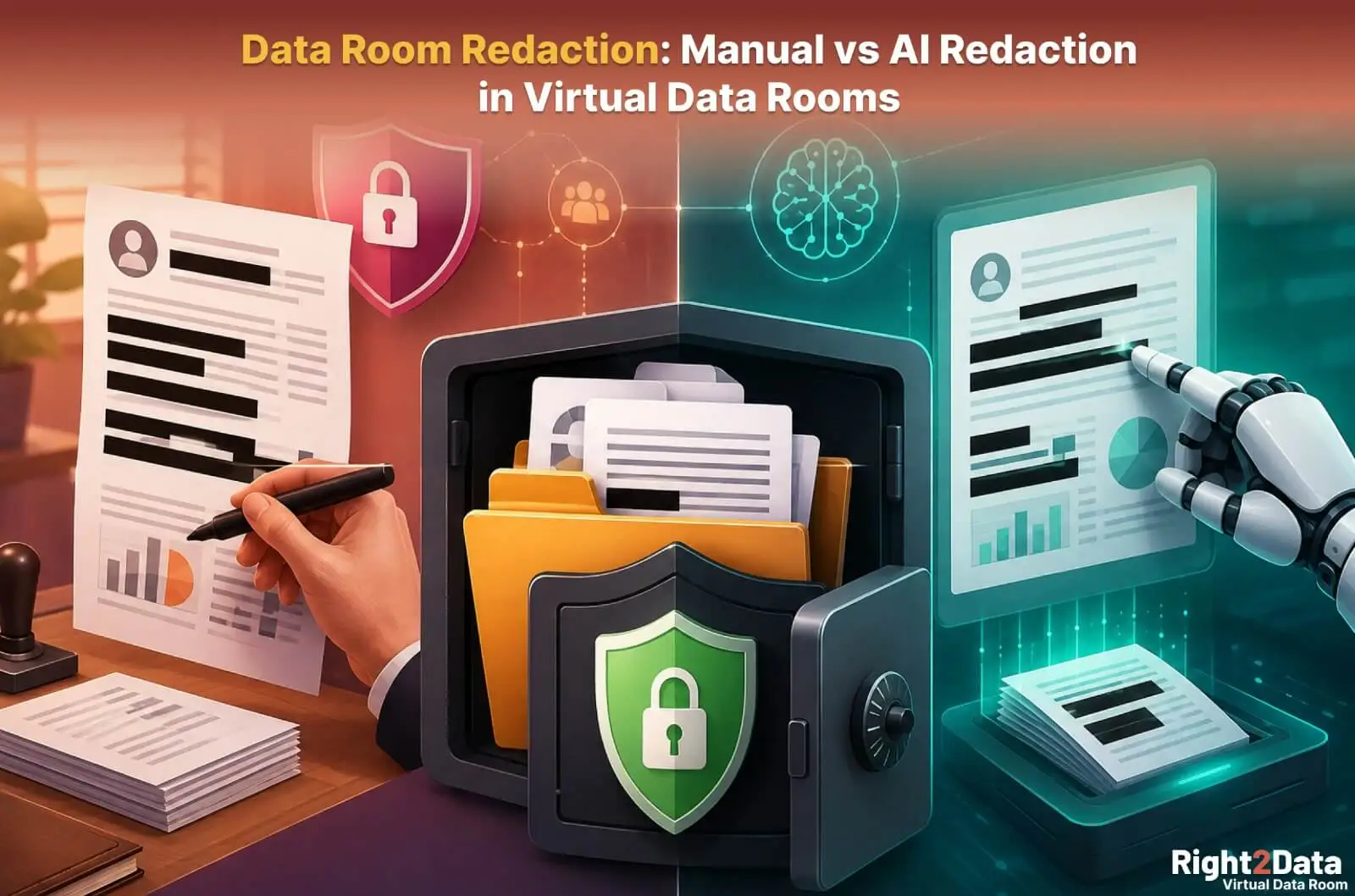 Document Redaction: Manual vs AI Redaction in Virtual Data Rooms | Right2Data VDR
-
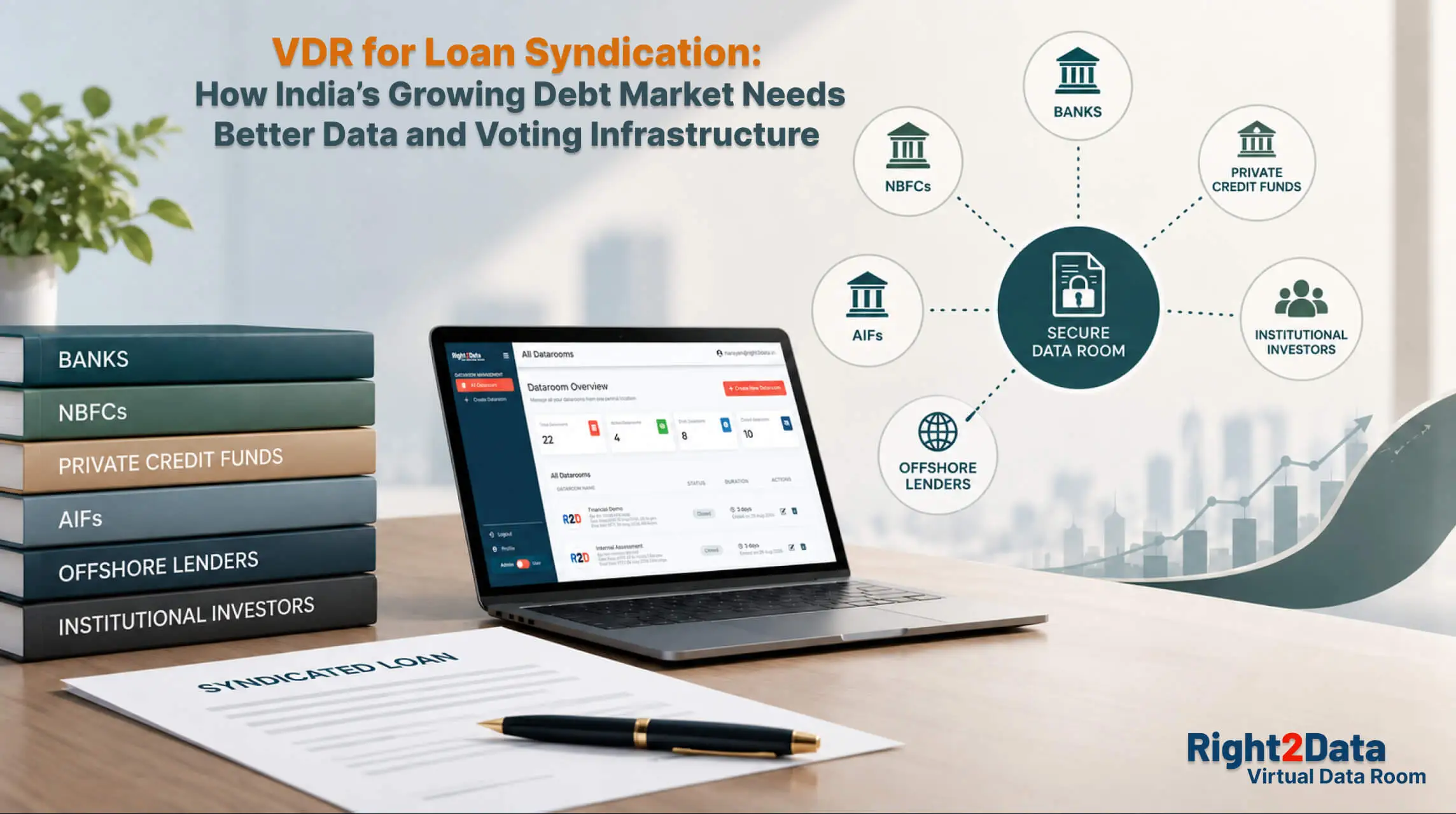 VDR for Loan Syndication: How India’s Growing Debt Market Needs Better Data and Voting Infrastructure
-
 How Right2Data VDR Implements Secure Manual Document Redaction