Document Redaction: Manual vs AI Redaction in Virtual Data Rooms | Right2Data VDR
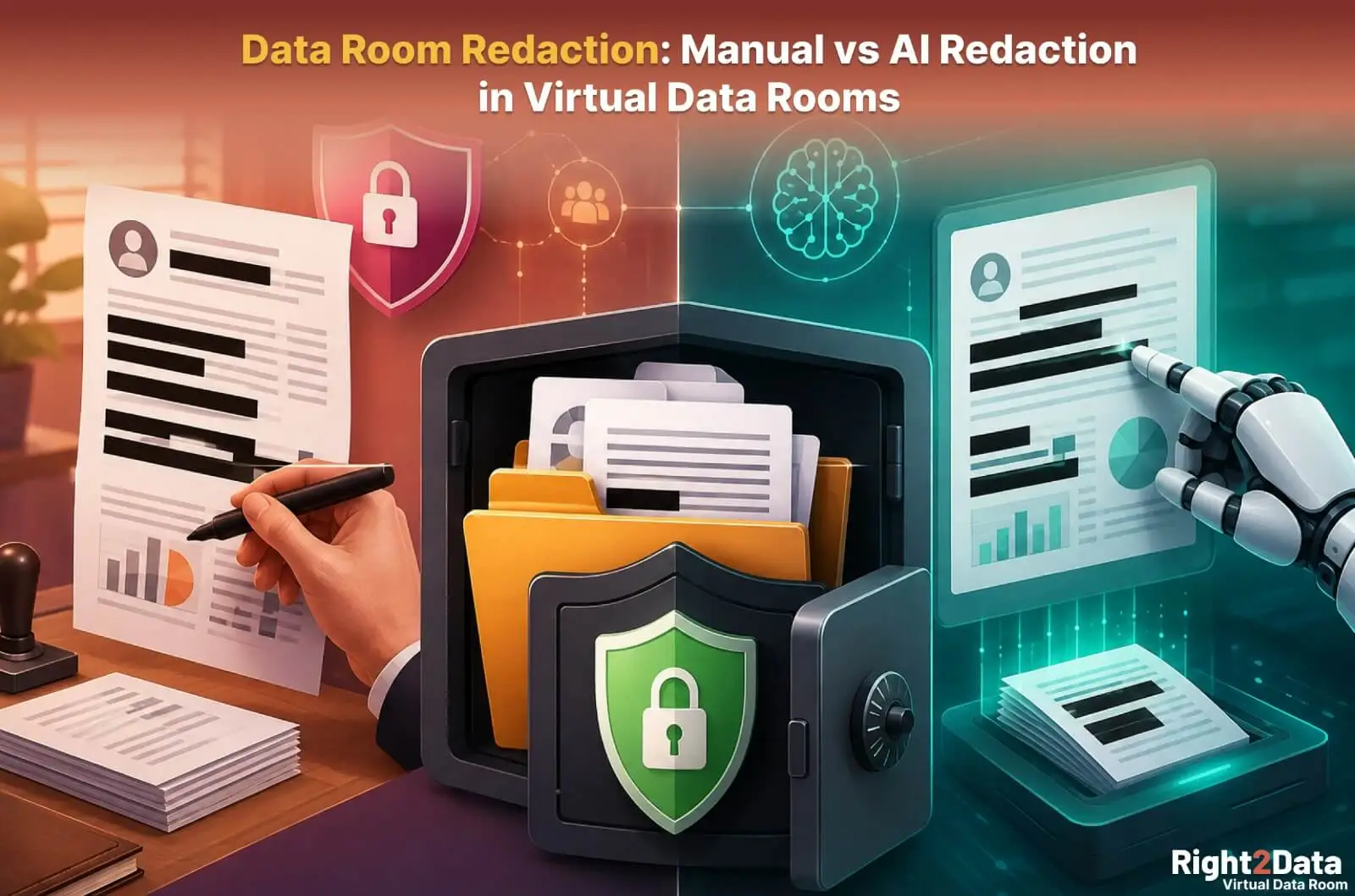
In today’s digital-first business environment, organisations exchange thousands of confidential documents every day. Whether it’s a merger and acquisition (M&A), due diligence, IPO, fundraising, insolvency proceedings (CIRP), legal litigation, or financial audit, businesses must share critical information with multiple stakeholders while protecting sensitive data.
Although Virtual Data Rooms (VDRs) provide a highly secure platform for storing and sharing confidential documents, not every section of a document should be visible to every user. Financial figures, pricing strategies, customer information, personally identifiable information (PII), intellectual property, or confidential legal clauses may need to remain hidden while the rest of the document is available for review.
This is where Data Room Redaction becomes indispensable.
Document redaction allows organisations to selectively hide confidential information before sharing files, enabling secure collaboration without exposing sensitive business data. It helps companies maintain compliance, reduce legal risks and control information disclosure throughout every stage of a transaction.
Today, many document management platforms offer AI-powered redaction, while enterprise-grade Virtual Data Rooms also provide manual redaction for greater precision. Understanding the differences between these approaches is essential when handling high-value corporate transactions.
What Is Data Room Redaction?
Data Room Redaction is the process of permanently concealing confidential information in a document before sharing it with authorised users in a Virtual Data Room (VDR) . Instead of restricting access to an entire document, administrators can hide only the information that should remain confidential while allowing reviewers to access the remaining content. This approach enables businesses to maintain transparency during document reviews without compromising commercially sensitive information.
For example, during due diligence, a company may need to share a supplier agreement with a potential investor. While the agreement itself is relevant, certain pricing formulas, customer identities, or confidential payment terms may not be ready for disclosure. By redacting only these sections, the company can continue the evaluation process while safeguarding sensitive information.
Similarly, legal teams frequently redact personal information, privileged legal advice, settlement amounts, or confidential clauses before sharing contracts with external parties. Financial institutions often hide bank account numbers, tax identifiers, or internal approval notes while providing lenders or auditors with the information necessary to complete their review. Modern Virtual Data Rooms like Right2Data VDR make this process simple, secure and auditable, ensuring that confidential information remains protected throughout the transaction lifecycle.
Redaction vs. Unredaction: What’s the Difference?
Although these terms are often used together, they serve very different purposes.
Redaction is the process of hiding or permanently masking confidential information within a document before it is shared. Once sensitive information has been redacted, it cannot be viewed by unauthorised users. Unredaction refers to restoring access to the original content. In some document management systems, administrators with appropriate permissions can access the original, unredacted document stored securely within the platform.
However, not every Virtual Data Room follows the same approach.
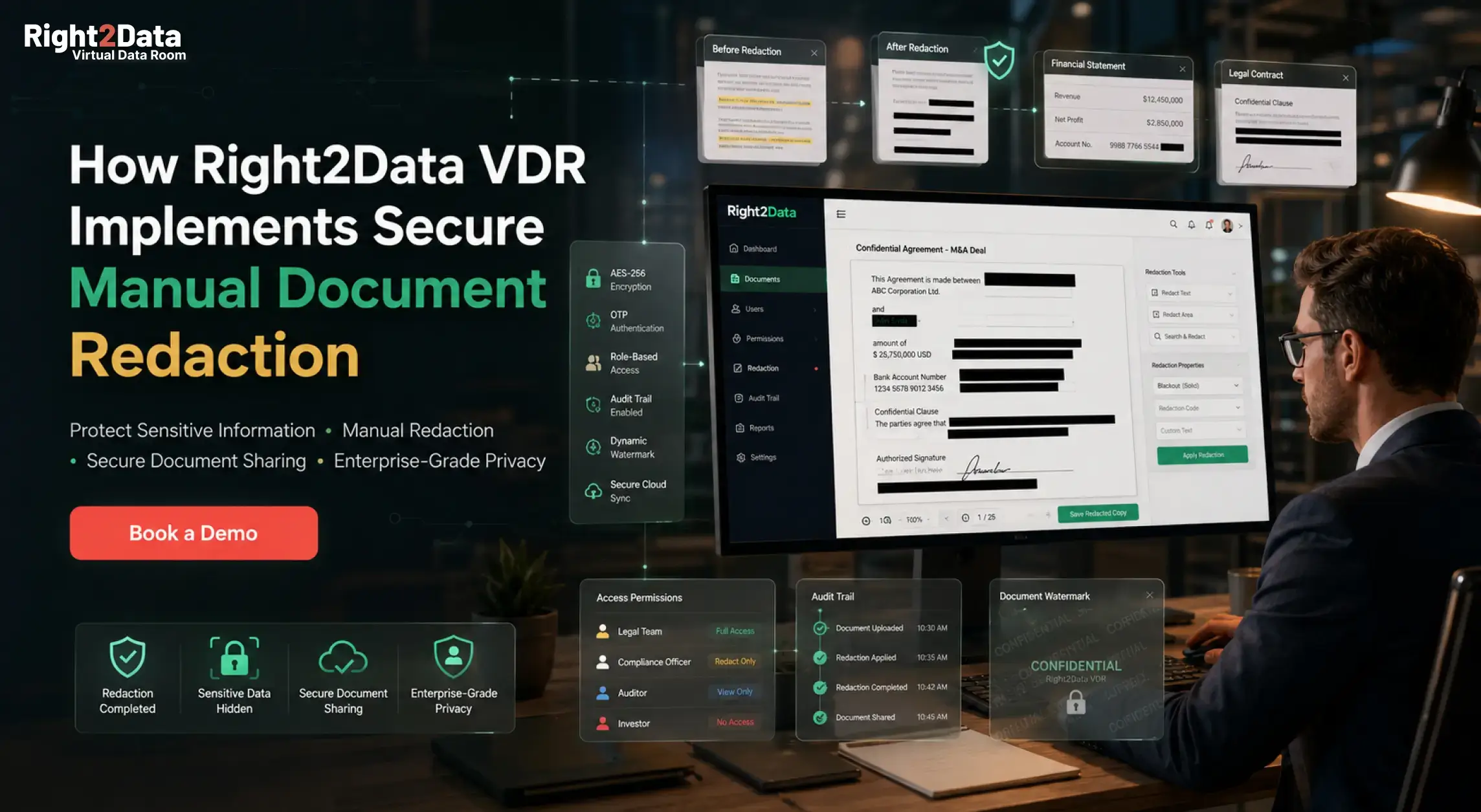
Right2Data VDR uses secure manual redaction, where once content is redacted, it cannot be unredacted within the redacted document. This ensures that confidential information cannot be accidentally restored or exposed, significantly reducing the risk of unauthorized disclosure. Organizations retain full control over the original document separately, while the shared version permanently protects sensitive information. This approach is particularly valuable for highly confidential transactions where even a single disclosure could result in financial, legal, or reputational damage.
Why Document Redaction Is Essential
Organizations today manage far more than simple contracts or financial statements. A typical Virtual Data Room may contain thousands of confidential documents, including:
- Shareholder agreements
- Board resolutions
- Financial statements
- Customer and supplier contracts
- Intellectual property records
- Employment agreements
- Regulatory filings
- Tax documents
- Litigation records
- Banking documents
- Technical drawings
- Compliance reports
Many of these documents contain information that is confidential but still needs to be reviewed by investors, auditors, lenders, legal advisors, or regulators.
Without proper redaction, businesses face several risks:
- Disclosure of confidential pricing strategies
- Exposure of customer or employee personal information
- Leakage of intellectual property
- Violation of privacy regulations
- Legal disputes resulting from unauthorized disclosures
- Loss of competitive advantage
- Damage to business reputation
Document redaction helps organizations share information confidently while ensuring that only the appropriate content is visible to each stakeholder. When combined with features of Right2Data like role-based permissions, dynamic watermarking, encryption, audit trails and secure authentication, redaction becomes a critical component of enterprise data security.
Manual Redaction Explained
Manual redaction is the process of reviewing each document individually and intentionally selecting the exact text, numbers, images, or sections that should remain hidden before the document is shared. Unlike automated systems, manual redaction relies on human expertise rather than predefined algorithms or pattern recognition. An authorized administrator evaluates the context of the document, understands its legal and commercial significance and determines precisely what information should be concealed.
For example, a purchase agreement may contain confidential pricing formulas embedded within ordinary-looking paragraphs. An experienced reviewer can identify these commercially sensitive details, even when they don’t follow a predictable format.
Because every document is examined individually, manual redaction remains the preferred choice for transactions involving sensitive legal, financial, or strategic business information.
Advantages of Manual Redaction
-
Higher Accuracy
Human reviewers understand the context of documents, reducing the likelihood of overlooking confidential information or unnecessarily hiding important content.
-
Better Contextual Understanding
Not every confidential detail follows a standard pattern. Manual reviewers can identify sensitive clauses, negotiation strategies, intellectual property, or commercially significant information that automated systems may miss.
-
Greater Administrative Control
Organisations decide exactly what information remains visible and what is permanently concealed. This level of control is particularly important during M&A transactions, IPO preparations and legal proceedings.
-
Reduced Business Risk
Manual review minimises the possibility of accidental disclosure that could impact negotiations, regulatory compliance, or customer trust.
-
Ideal for High-Value Transactions
Manual redaction is widely preferred for:
- Mergers & Acquisitions (M&A)
- Due Diligence
- Initial Public Offerings (IPOs)
- Banking & Financial Services
- CIRP & Insolvency Proceedings
- Legal & Litigation Management
- Venture Capital Fundraising
Although manual redaction may require more time than automated solutions, the additional accuracy and security make it the preferred approach for protecting highly confidential business information.
AI-Based Redaction
Artificial Intelligence has transformed document management by automating repetitive tasks, including document redaction. AI-powered redaction software uses machine learning, natural language processing (NLP) and pattern recognition to automatically identify predefined categories of sensitive information such as names, email addresses, phone numbers, identification numbers, dates and addresses.
For organizations processing large volumes of standardized documents, AI can significantly reduce the time required to identify potentially sensitive content. Thousands of pages can be scanned within minutes, making AI an attractive option for preliminary reviews and routine compliance projects.
However, AI primarily recognises patterns but not the business intent. It cannot fully understand legal context, commercial sensitivity, or strategic implications in the same way an experienced human reviewer can. As a result, AI-generated redactions should always be verified before confidential documents are shared with external stakeholders.
The Risks of AI-Based Redaction
Artificial Intelligence has made document processing faster and more efficient, but when it comes to protecting highly confidential information, speed should never come at the cost of accuracy. While AI-powered redaction can identify common patterns such as names, email addresses, phone numbers and identification numbers, it lacks the contextual understanding required for complex legal, financial and commercial documents.
For organizations involved in mergers and acquisitions, due diligence, IPOs, legal proceedings, or fundraising, even a single redaction error can result in financial losses, regulatory penalties, or reputational damage.
That’s why AI-generated redactions should always be reviewed by a human before confidential documents are shared.
1. Lack of Contextual Understanding
AI excels at recognizing patterns but struggles to interpret business intent.
For example, a paragraph discussing pricing strategies may not contain any obvious personal information, yet it could reveal confidential negotiation tactics or proprietary business models. An experienced reviewer can identify the strategic value of this information, whereas AI may treat it as ordinary text.
Similarly, legal contracts often contain clauses that appear routine but have significant commercial implications. Without understanding the context, AI may leave these sections visible, increasing the risk of unintended disclosure.
2. False Negatives
A false negative occurs when AI fails to identify confidential information that should have been redacted.
Examples include:
- Confidential pricing formulas
- Internal approval notes
- Customer-specific discounts
- Proprietary manufacturing processes
- Strategic business plans
- Sensitive legal clauses
Missing even one confidential detail can expose valuable business information to unauthorized parties, potentially affecting negotiations, compliance, or competitive positioning.
3. False Positives
AI can also over-redact documents by hiding information that should remain visible.
Excessive redaction often creates confusion for investors, auditors, legal advisors and regulators, who may struggle to interpret incomplete documents. This leads to additional clarification requests, delays in due diligence and unnecessary administrative work.
The goal of redaction is to protect confidential information, not to make documents unreadable.
4. Industry-Specific Terminology
Many industries use highly specialised language that AI models may not consistently interpret.
For example:
- Legal agreements contain complex contractual clauses.
- Financial documents include valuation models and accounting terminology.
- Pharmaceutical companies manage clinical trial data and research documents.
- Engineering companies handle proprietary technical drawings and design specifications.
Without industry expertise, AI may fail to identify sensitive information or incorrectly redact non-confidential content.
5. Multilingual Documents
Cross-border transactions often involve documents written in multiple languages.
Although AI technology continues to improve, multilingual legal and financial documents remain challenging. Differences in legal terminology, formatting and regional language variations can reduce the accuracy of automated redaction, making human review essential.
6. Regulatory and Compliance Risks
Organisations must comply with data protection regulations while ensuring that confidential business information is disclosed only to authorized parties.
If AI overlooks sensitive personal or commercial information, businesses may face:
- Privacy violations
- Regulatory penalties
- Contractual disputes
- Loss of stakeholder trust
For regulated industries such as banking, healthcare, legal services and financial institutions, these risks are too significant to ignore.
Manual Redaction vs AI Redaction
Choosing between Manual and AI Redaction depends on the nature of the transaction, document sensitivity and acceptable level of risk.
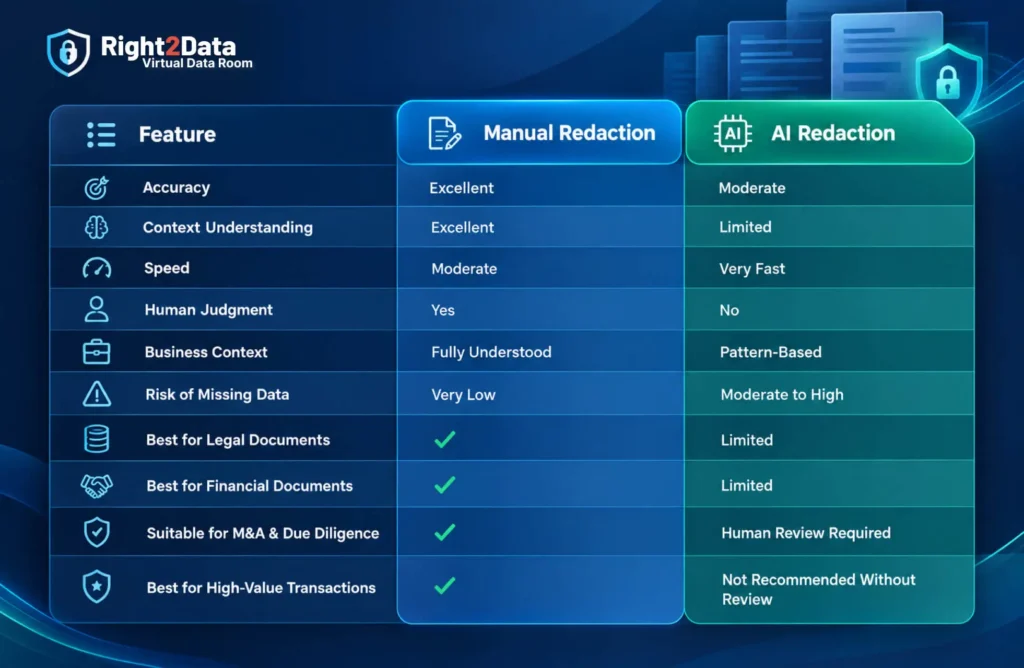
While AI offers speed and efficiency for processing large volumes of documents, manual redaction remains the preferred choice for transactions involving confidential legal, financial, or strategic business information. The additional time required for manual review is often justified by the higher level of accuracy and reduced business risk.
Where Is Data Room Redaction Used?
Document redaction is a critical security feature across industries that regularly exchange confidential information. It enables organizations to share documents securely while protecting commercially sensitive data and complying with privacy regulations.
-
Mergers & Acquisitions (M&A)
During M&A transactions, sellers share financial records, legal agreements, intellectual property and customer contracts with potential buyers. Redaction allows organizations to hide pricing formulas, customer identities, supplier details, or proprietary methodologies until later stages of the transaction.
-
Due Diligence
Due diligence often involves thousands of confidential documents reviewed by investors, auditors, lenders and legal advisors. Since each stakeholder requires different levels of access, redaction ensures that only relevant information is disclosed without maintaining multiple versions of the same document.
-
Initial Public Offerings (IPOs)
Companies preparing for an Initial Public Offering IPO must share extensive documentation with merchant bankers, auditors, legal advisors and regulators. Redaction helps control information disclosure while maintaining document consistency throughout the listing process.
-
Legal & Litigation
Law firms regularly redact privileged legal advice, settlement amounts, personal information, and confidential clauses before sharing documents with external parties or courts. This protects client confidentiality while supporting legal proceedings.
-
Banking & Financial Services
Banks, private equity firms, venture capital investors and asset management companies frequently share sensitive financial documents during fundraising, loan syndication, portfolio reviews and investment transactions. Redaction safeguards confidential financial information while enabling secure collaboration.
-
Healthcare & Life Sciences
Healthcare organisations, pharmaceutical companies and biotech firms use redaction to protect patient records, clinical trial data, research findings and proprietary intellectual property while complying with privacy regulations.
-
Government & Public Sector
Government departments and public sector organisations rely on redaction during procurement processes, infrastructure projects and strategic partnerships to protect classified information and commercially sensitive bid details.
Frequently Asked Questions (FAQs)
1. What is Data Room Redaction?
Data Room Redaction is the process of permanently hiding confidential information within documents before sharing them in a Virtual Data Room (VDR). It allows businesses to disclose only the information required by investors, auditors, legal advisors, or regulators while protecting sensitive financial, legal, commercial and personal data during transactions such as due diligence, M&A and IPOs.
2. What is the difference between Manual Redaction and AI Redaction?
Manual Redaction is performed by a human reviewer who understands the business and legal context of a document, while AI Redaction automatically identifies predefined patterns using machine learning. Although AI is faster for processing large document volumes, manual redaction provides greater accuracy and is preferred for confidential transactions where even a single disclosure can create legal or commercial risks.
3. Is Manual Redaction more secure than AI Redaction?
Yes. Manual Redaction is generally considered more secure because it evaluates the context of every document rather than relying solely on pattern recognition. It minimizes the risk of missed confidential information, over-redaction and inaccurate disclosures, making it the preferred choice for M&A, due diligence, IPOs, legal proceedings and banking transactions.
4. Which documents should be redacted in a Virtual Data Room?
Organizations commonly redact financial statements, shareholder agreements, customer contracts, supplier agreements, employment contracts, tax records, legal documents, board resolutions, compliance reports and personally identifiable information (PII). Redaction ensures confidential information remains protected while allowing stakeholders to review the relevant parts of each document.
5. Why is Data Room Redaction important during Due Diligence?
During due diligence, organizations share confidential documents with multiple stakeholders who often require different levels of access. Virtual Data Room Redaction allows companies to protect sensitive pricing, customer information, trade secrets and legal clauses while maintaining transparency, reducing legal risk and ensuring secure collaboration throughout the transaction.
Choose Right2Data VDR for speed, security and success in 2026. India’s Most Affordable Virtual Data Room for Mergers, Acquisitions, Due Diligence, IPOs and Beyond.
Table of Contents :
Important links :
Recent Blogs :
-
Document Redaction: Manual vs AI Redaction in Virtual Data Rooms | Right2Data VDR
-
 VDR for Loan Syndication: How India’s Growing Debt Market Needs Better Data and Voting Infrastructure
-
 How Right2Data VDR Implements Secure Manual Document Redaction
-
 How Modern Asset Management Companies Are Transforming Information Management with Secure Virtual Data Rooms