Virtual Data Rooms (VDR) vs Google Drive : The Complete Guide
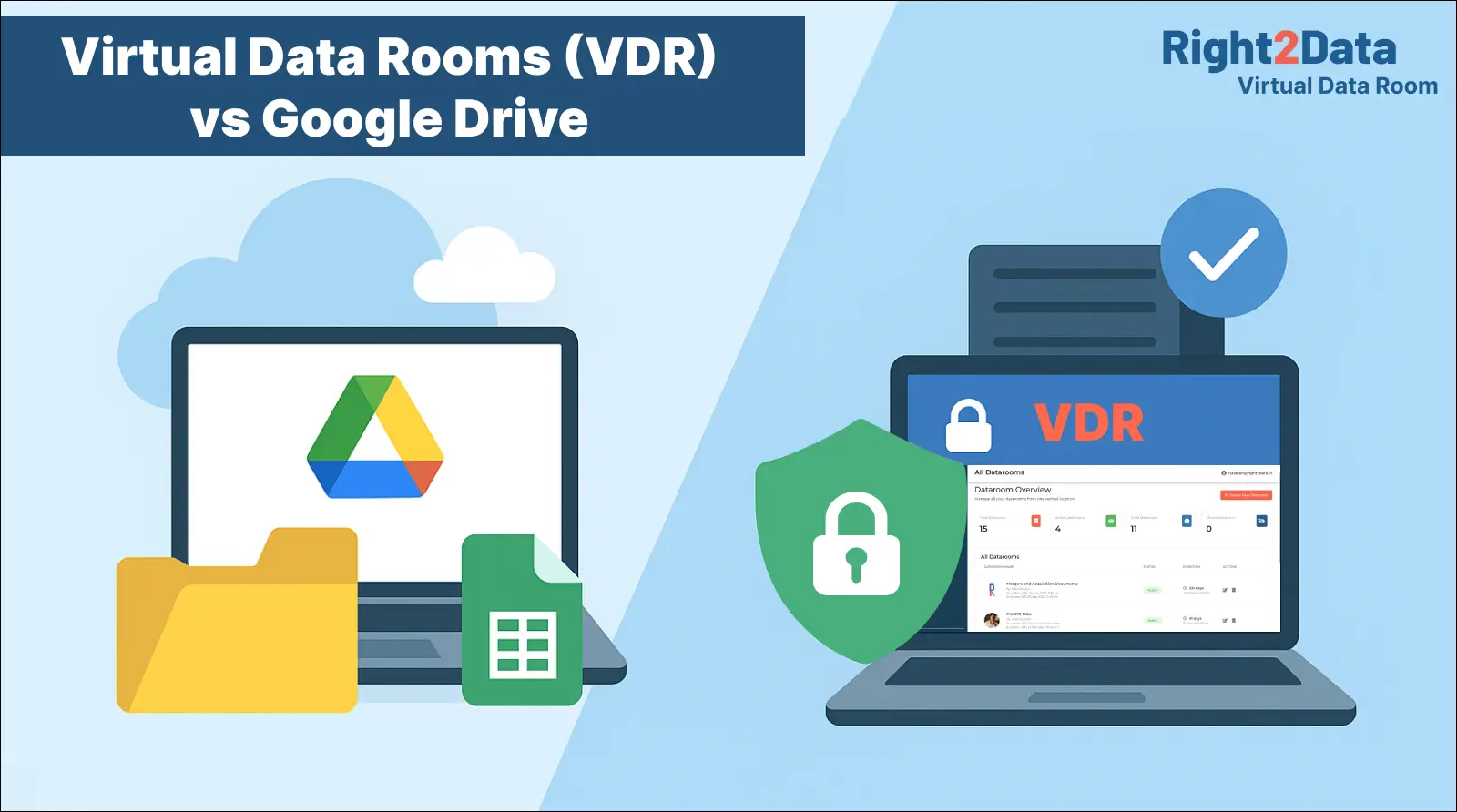
When to use a VDR and when is Google Drive OK?
Google Drive is perfect for internal collaboration, co-editing documents, shared team drives, and ongoing corporate knowledge management. It integrates seamlessly with Google Workspace apps and offers affordable storage for routine use. Conversely, a Virtual Data Room, especially a secure, India-friendly platform like Right2Data VDR, is a specialised time-bound transactional environment designed to store, share, and monitor confidential files with persistent seller user/viewer control. Use a VDR for any project that involves external stakeholders and legal risk, M&A due diligence, IPO/DRHP preparation, fundraising data rooms, legal discovery, or insolvency. The prohibitive pricing of VDR providers vs a free Google Drive access was the major barrier in the past for low adoption of a data room in India in the past.
The practical choice should be driven by risk; pick Google Drive for everyday work and a purpose-built VDR like Right2Data VDR, where confidentiality, auditability, and compliance matter.
Why is VDR adoption accelerating in India?
The Virtual Data Room market is expanding quickly worldwide and in India. Industry analyses show strong CAGR projections for VDR adoption as remote work, digital dealmaking and stricter compliance norms push organisations away from ad-hoc file sharing. In India specifically, market research estimated the VDR sector generated over USD 100 million in 2024 and forecasted rapid growth through 2030, a sign that corporates, banks, law firms and startups are increasingly using cloud VDRs such as Right2Data VDR for transaction workflows.
These dynamics show that deal counterparties and regulators increasingly expect deal-grade VDR environments as the default. At the same time, India is building out large-scale data centre capacity, enabling India-hosted VDR options that reduce latency and support data sovereignty. This is one of the core strengths of Right2Data VDR, which offers India-based hosting for improved performance and compliance.
Legal & regulatory considerations (why geography matters?)
India’s Digital Personal Data Protection (DPDP) Act and related rules emphasise privacy, security, and accountability. While the DPDP Act does not mandate full data localisation for all personal data, sectoral guidelines have leaned toward stronger local safeguards. For many Indian transactions, especially those involving regulated sectors, choosing a VDR provider hosting in India, such as Right2Data VDR, reduces legal risk and simplifies audits.
A VDR provider that understands DPDP obligations and Indian compliance culture helps prevent regulatory friction. Right2Data VDR, with its India-aware safeguards and optional local hosting, aligns well with these expectations.
Security comparison (Architecture and practical controls)
A Virtual Data Room is engineered with layered security controls that prevent leakage and provide forensic visibility. Most VDRs, including Right2Data VDR, encrypt data at rest and in transit, enforce multi-factor authentication, and enable granular role-based permissions. Beyond the basics, VDRs include document-level DRM, secure in-browser file viewers, Multiple admins, dynamic watermarking, IP/device restrictions, time-bound access and immutable audit logs recording every view with timestamps and IP addresses.
These capabilities maintain persistent seller control during high-stakes deals, something that everyday tools cannot offer.
Google Drive also provides strong baseline enterprise security, encryption, MFA, admin logs, and device management, but it is designed for collaboration, not a transaction-grade professional environment. Drive lacks built-in forensic page-level logs, persistent DRM, advanced watermarking, or screenshot deterrence.
For legally sensitive work, Right2Data VDR’s security model provides the “deal-grade” professional environment and protection that Drive is simply not built for.
Permissions and governance (Granular control vs broad sharing)
Permissions are the heart of controlled access, where VDRs allow administrators to manage access at the file and folder level, enforce view-only rules, prevent downloads, set expirations, and restrict access by IP or geography. Platforms like Right2Data VDR also support structured Q&A modules, audit trails and activity logs designed for legal defensibility.
Google Drive’s sharing model is user-friendly but broad and difficult to tightly control at scale. A forwarded link or mistakenly added email can compromise confidentiality. Workspace admins can mitigate some risks, but Drive lacks persistent seller-side restrictions that ensure files cannot be extracted, copied, or screenshot easily.
Where confidentiality is critical, a VDR like Right2Data VDR provides a governance model built for secure transactions.
Features, workflows, and transaction intelligence
VDRs offer transaction-oriented workflows: M&A-ready folder structures, audit trails, Q&A systems, bidder comparison, redaction tools, deal analytics and AI-assisted document indexing. These features, central to platforms like Right2Data VDR, provide intelligence and structure that accelerate due diligence.
Google Drive excels at real-time collaboration and document creation, but lacks transaction-specific workflows. It does not provide native redaction tools, Q&A workflows, bidder heat maps, or intelligence on which parties engaged most deeply with deal documents.
Organizations that need structured, high-stakes workflows will find a Right2Data VDR-style platform significantly more effective.
Cost (Balancing fees and risk)
Cost must be evaluated based on risk and use case. Google Drive is affordable for storage and long-term internal collaboration. Historically, VDRs were expensive, but the market has matured, newer providers like Right2Data VDR offer India-priced, transparent, SME-friendly plans with subscription or per-deal models.
For fundraising, M&A, or regulated transactions, the cost of a breach or delayed deal far outweighs VDR pricing. For Indian startups and mid-market firms, Right2Data VDR’s transparent, affordable pricing offers strong ROI and avoids the hidden per-user fees of many global VDRs.
User experience and onboarding (Getting teams to adopt the right tool)
User adoption is essential. Google Drive has a near-zero learning curve. To match this ease, VDR providers like Right2Data VDR focus on intuitive UI, prebuilt templates for M&A/IPO workflows, guided onboarding, and support teams available in IST time zones.
A VDR with strong onboarding support reduces friction and increases adoption across legal, finance, and operations teams. Right2Data VDR’s simplified setup, which can be achieved within 5 minutes, helps teams migrate from Drive or local storage with minimal effort.
Real-world Indian examples & use cases
A Bengaluru SaaS startup preparing for Series B needs to share sensitive financials and IP with multiple investors. A VDR such as Right2Data VDR enables secure, view-only access with dynamic watermarks that identify each viewer. The startup can monitor investor engagement and prioritise serious bidders.
A Mumbai-listed company preparing for a SEBI-reviewed IPO benefits from an India-hosted VDR to reduce latency for underwriters, auditors, and lawyers. Using a compliant platform like Right2Data VDR ensures quicker access and smoother audit readiness.
For insolvency (IBC) practitioners or law firms preparing for litigation, Right2Data VDR’s forensic audit trail and premium security tools provide reliable evidence during court scrutiny, far beyond what Google Drive can supply.
Selecting the right solution (A practical checklist for Indian buyers)
When choosing between Google Drive and a VDR, verify:
- Is a forward of the link enough to access the documents?
- Is there OTP based security?
- Does the platform support view-only?
- Is the platform Security compliant?
- Does it provide granular permission settings?
- Does it support multiple Administrators?
- Are audit logs immutable with IP + timestamp?
- Is India hosting available?
- Are deal workflows (Q&A, indexing, bulk permissions) included?
- Is the pricing transparent and affordable?
- Is support available in IST?
A solution like Right2Data VDR checks all these boxes.
Choose based on risk and business context
Google Drive remains an excellent, low-cost productivity tool for internal work and ongoing collaboration. However, it is not a substitute for a Virtual Data Room when your project involves external counterparties, legal exposure, or regulatory scrutiny. For M&A, IPO preparation, insolvency processes, investor due diligence, and litigation, a deal-grade platform like Right2Data VDR provides the necessary auditability, confidentiality and India-aware hosting.
For everyday work, keep Google Drive, but when the stakes are high, choose a specialised VDR. A platform like Right2Data VDR protects value, accelerates deals, and provides the audit evidence modern regulators expect.
Frequently Asked Questions
1. What is the main difference between a Virtual Data Room and Google Drive?
A Virtual Data Room (VDR) like Right2Data VDR is built specifically for secure, controlled and compliant sharing of confidential documents during transactions such as M&A, IPO, due diligence and litigation. Google Drive is designed for everyday collaboration and general file storage but lacks the legal-grade auditability, document-level DRM controls and forensic logging required in high-risk transactions.
2. Why is a VDR safer than Google Drive for confidential business documents?
A VDR offers document-level encryption, view-only access, dynamic watermarking, IP restrictions, time-bound access, screenshot deterrence and immutable audit logs. Right2Data VDR enhances this with India-hosted cloud storage and DPDP-aware security safeguards. Google Drive provides strong encryption but does not include these forensic, deal-grade controls.
3. When should Indian businesses choose a VDR instead of Google Drive?
Choose a VDR when handling external parties or high-risk processes such as fundraising, M&A, IPO, DRHP preparations, banking audits, insolvency (IBC), legal disputes and vendor diligence. Google Drive works well for daily teamwork but not for regulated or confidential transactions. For Indian businesses, Right2Data VDR is the preferred choice due to local hosting and compliance readiness.
4. Is Google Drive secure enough for due diligence?
No. Due diligence requires strict access control, forensic logs, bidder analytics, and persistent seller control, which Google Drive does not provide. Only a purpose-built VDR like Right2Data VDR meets due diligence-grade standards and provides audit-proof visibility.
5. Why do investors and lawyers prefer VDRs over Google Drive?
Investors, bankers, and legal teams expect structured folder indexing, Q&A modules, restricted access, and clear audit trails to manage risk and verify compliance. These capabilities are built into Right2Data VDR, making it easier for all parties to collaborate securely.
6. Does Google Drive offer activity tracking like a VDR?
Google Drive includes general admin logs, but it does not track who viewed which page, how long they spent, or which document sections attracted interest. Right2Data VDR offers deep document analytics for buyer intent, investor interest, and due diligence heatmaps.
7. Is a VDR expensive compared to Google Drive?
Modern VDRs, especially India-focused ones like Right2Data VDR, are now affordable, subscription-based, and priced for SMEs and startups. For high-stakes transactions, the cost of not using a VDR (data leak, deal delay, compliance failure) is far higher than the subscription fee. We have very reasonable pricing, which lowers the barrier to switching from a free to a professional paid service.
8. Can Google Drive prevent downloads or screenshots?
Google Drive cannot reliably enforce no-download, no-copy, or anti-screenshot controls. A VDR like Right2Data VDR uses secure document viewers, DRM controls and dynamic watermarks to prevent unauthorized extraction and trace leaks if they occur.
9. Do VDRs like Right2Data support India-based data hosting?
Yes. Right2Data VDR offers India-hosted cloud infrastructure to support low latency, faster access and compliance with DPDP and sectoral data requirements, which many Indian regulated entities prefer.
10. What types of companies in India use VDRs?
VDRs are utilized by startups, NBFCs, listed companies, banks, law firms, insolvency professionals, private equity firms, and enterprises during fundraising, M&A transactions, IPOs, litigation, audits, vendor diligence and secure cross-border data sharing. Right2Data VDR is optimized specifically for these use cases.
11. Can Google Drive replace a VDR for M&A or fundraising?
No. M&A and investor due diligence require secure folders, viewer-by-viewer control, audit logs and structured workflows that Google Drive cannot provide. Right2Data VDR is specifically designed for high-risk, multi-party processes.
12. How does a VDR improve deal speed compared to Google Drive?
VDRs include automatic indexing, pre-built M&A templates, deal analytics, group permissions and Q&A workflows that reduce time-consuming admin work. Right2Data VDR helps Indian businesses complete due diligence processes faster with structured digital rooms and faster India-based cloud performance.
13. Can a VDR be used for everyday document storage like Google Drive?
While possible, it is not necessary. Use Google Drive for routine files. Use Right2Data VDR for confidential, high-risk, or multi-party transactions requiring legal-grade protection.
14. Which is better for IPO preparation, VDR or Google Drive?
A VDR is better because IPO documentation and DRHP filings require granular access control, cross-team collaboration, auditability and DPDP compliance. Right2Data VDR is built to support India-focused IPO workflows and is User-friendly.
15. Should Indian companies choose an India-based VDR provider?
For faster access, lower latency, DPDP comfort, and easier compliance audits, an India-based VDR like Right2Data VDR is often the best choice. Local support in IST also makes onboarding and troubleshooting faster compared to global tools. Moreover, all this is at a fraction of the cost of international VDR providers, which ensures that the extension of the data room is merely a convenience choice and does not become an additional optimization point on the project cost and time.
Table of Contents :
Important links :
Recent Blogs :
-
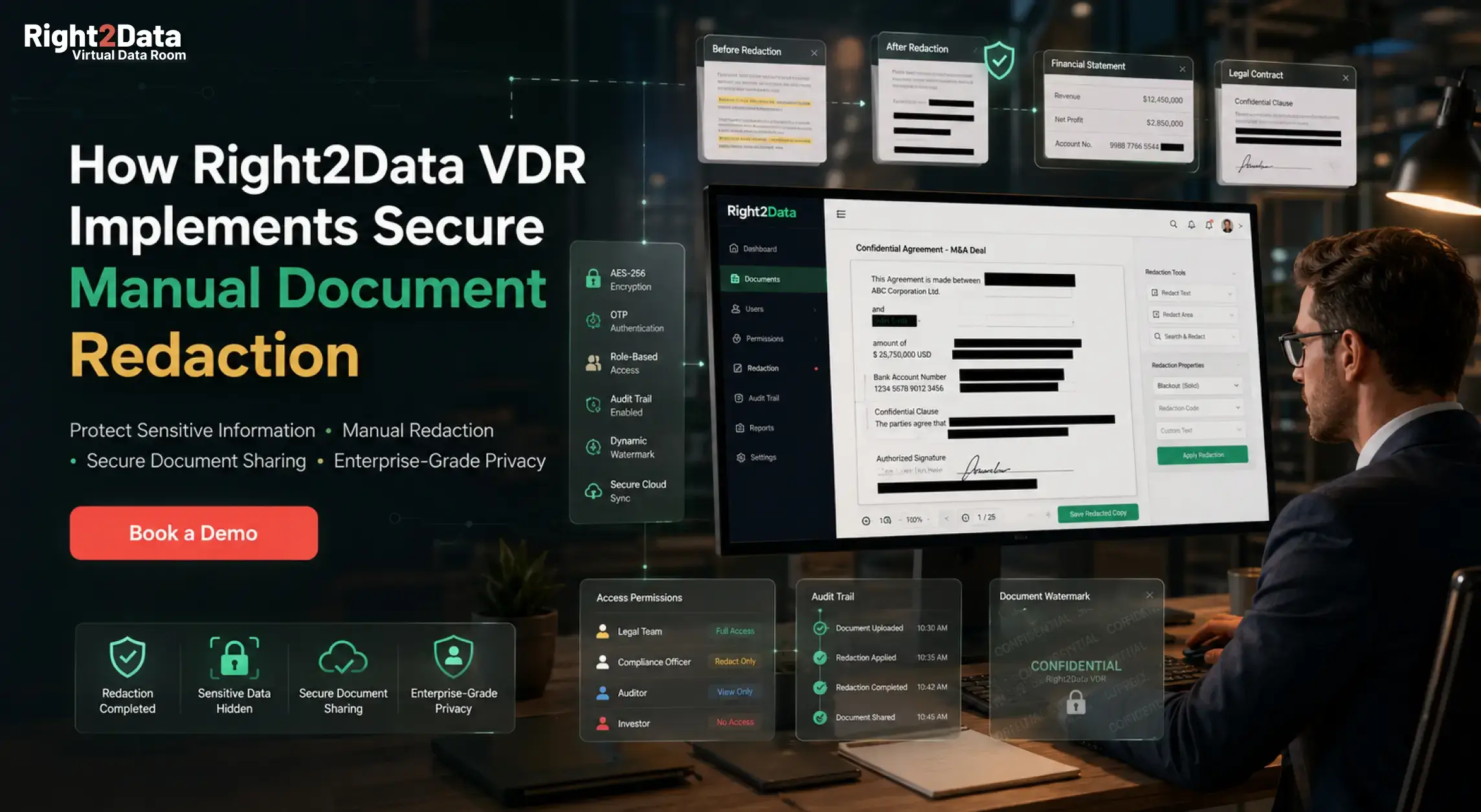 How Right2Data VDR Implements Secure Manual Document Redaction
-
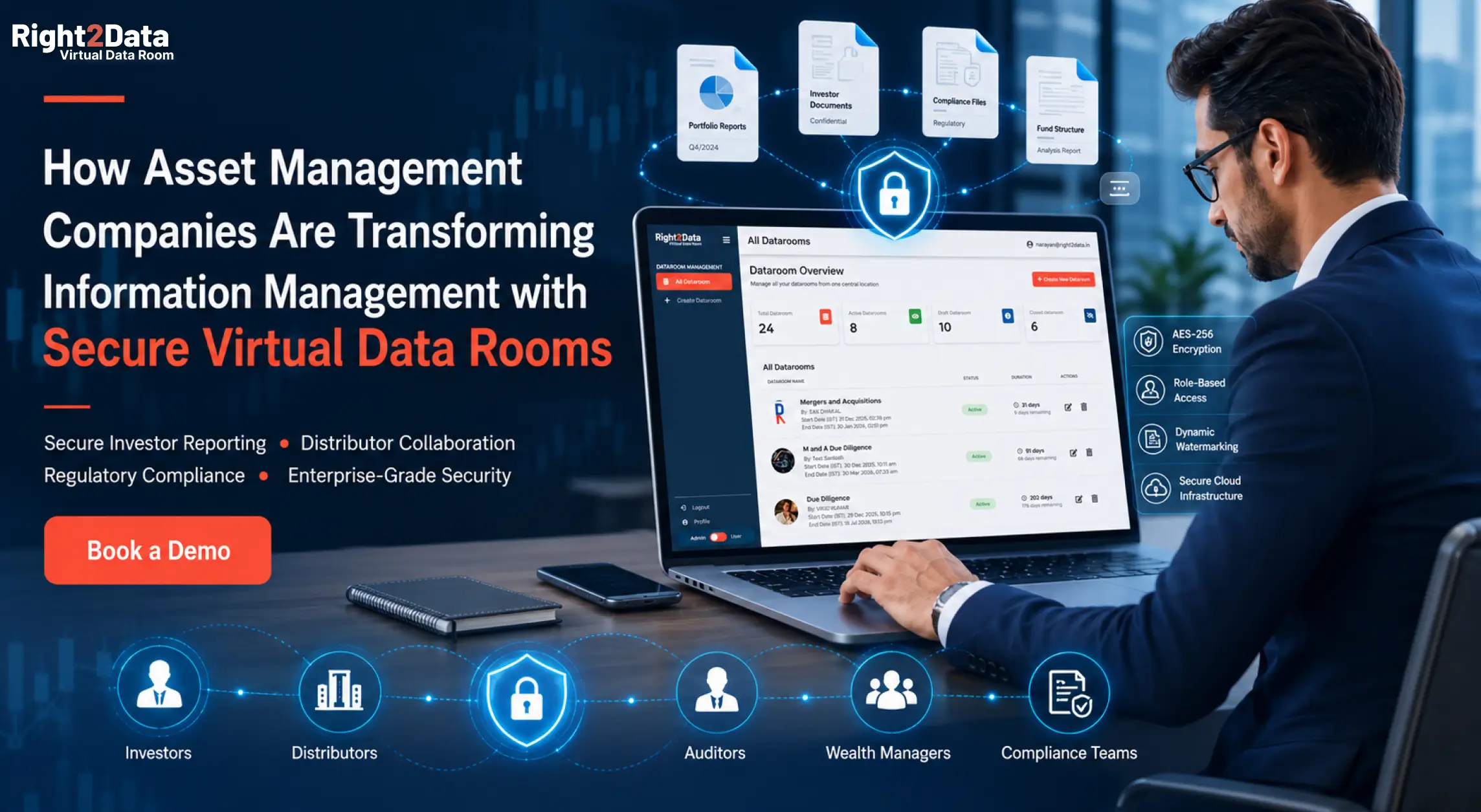 How Modern Asset Management Companies Are Transforming Information Management with Secure Virtual Data Rooms
-
 Startup Fundraising in 2026: Why Virtual Data Rooms (VDRs) Are Essential for Venture Capital Due Diligence
-
 Uses of Virtual Data Rooms (VDRs) in the Financial Sector: What Financial Advisors Cannot Afford to Miss in a Modern Data Room