Top 10 Virtual Data Room Features Every Start-ups Needs in 2026
Introduction:
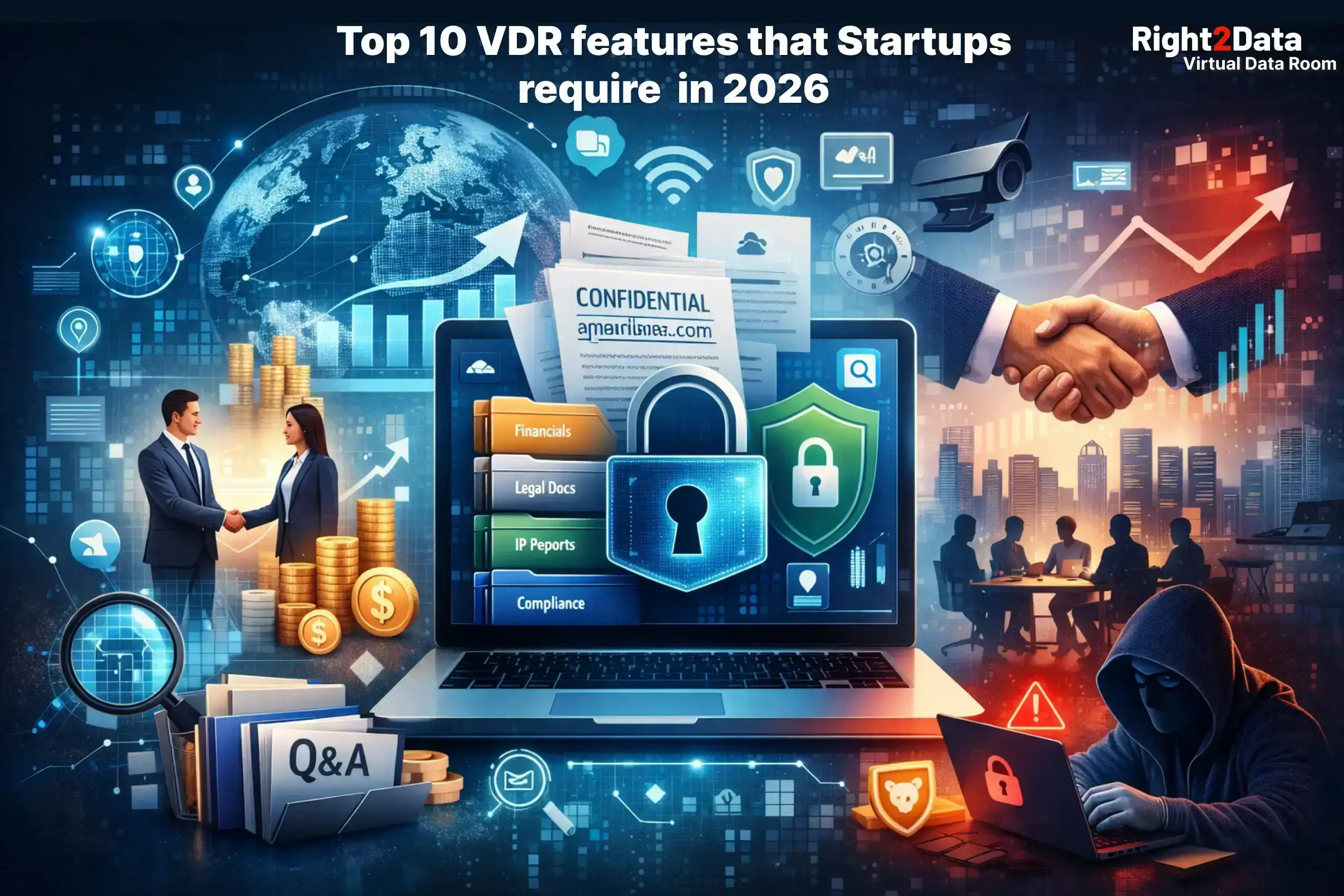
Startup fundraising and mergers & acquisitions (M&A) activities have become faster, more global, and more data-intensive than ever before. Investors now expect structured access to financials, legal documentation, intellectual property records and compliance reports, all in a professionally managed and secure environment.
At the same time, cybersecurity risks are increasing. Data leaks, ransomware attacks, and regulatory penalties have made secure document sharing a board-level priority. Unauthorized sharing of information with competitors is another challenge. There is more than a small chance that an interested buyer might even become a competitor if he is not one already!
This is where a Virtual Data Room (VDR) becomes an essential tool.
A modern virtual data room is not just cloud storage. It is a secure, permission-based, analytics-enabled platform built specifically for high-stakes transactions like:
- Startup fundraising (Seed, Series A, Series B+)
- Mergers & Acquisitions (M&A)
- Strategic partnerships
- IPO preparation
- Legal and compliance reviews
In 2026, choosing the right VDR is no longer optional; it is a competitive advantage, not just a security hygiene.
At Right2Data VDR, we work closely with startups, investment bankers, insolvency professionals, and legal teams. Based on real transaction experience, here are the top 10 virtual data room features every startup must prioritize in 2026.
What Is a Virtual Data Room?
A Virtual Data Room is a secure online repository used to store and share confidential business documents with controlled access.
Unlike general cloud storage platforms, a VDR provides:
- Granular user permissions
- Document-level security controls
- Full audit trails
- Investor engagement tracking
- Compliance-grade encryption
- Structured Q&A workflows
For startups preparing for investor due diligence, a VDR ensures transparency while maintaining strict control.
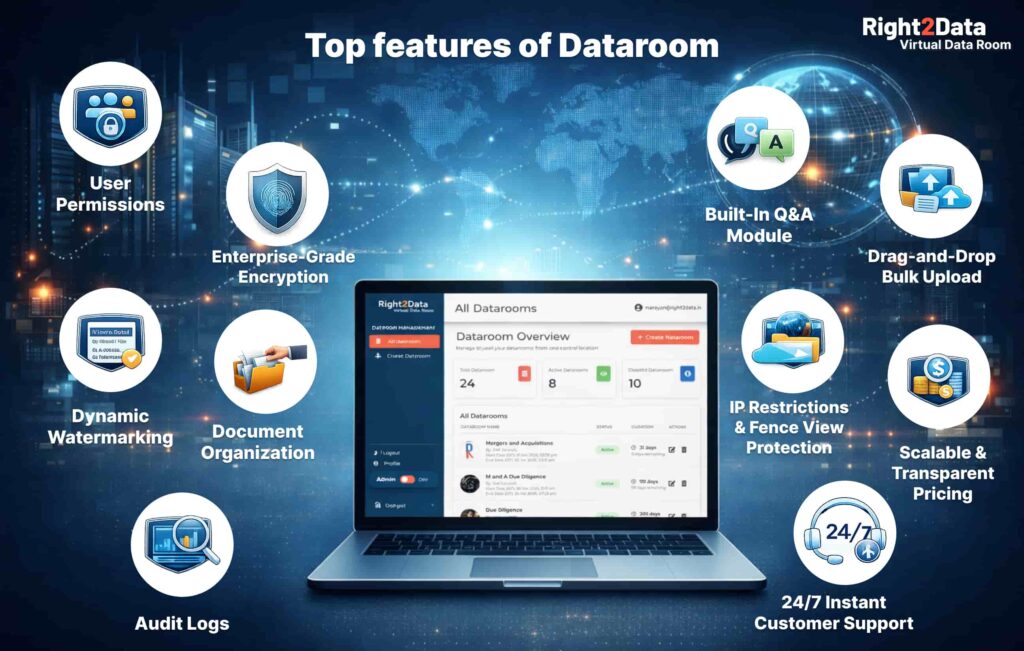
Top 10 Virtual Data Room Features for Startups in 2026
1. Granular User Permissions & Role-Based Access
Not every investor should see every document.
Modern VDRs allow startups to:
- Assign Admin, Editor, and Viewer roles
- Restrict access at the folder or file level
- Control viewing, downloading, and printing
- Set expiry dates for access
This ensures sensitive IP, financial models, or board documents are shared only with the right stakeholders.
For startups managing multiple investor conversations simultaneously, granular permissions are critical.
2. Enterprise-Grade Encryption & Compliance
Security is the backbone of any serious data room.
In 2026, startups should demand:
- AES-256 encryption at rest
- TLS 1.3 encryption in transit
- Multi-Factor Authentication (MFA)
- ISO 27001 or SOC 2 compliance
- GDPR-ready infrastructure
With regulatory oversight tightening globally, compliance-backed security builds investor trust and reduces legal exposure. Learn more about our enterprise-grade VDR security standards.
3. Dynamic Watermarking
When sharing confidential documents like cap tables, financial projections, or patents, leakage risk must be minimized.
- Embeds viewer name, email, timestamp and IP address
- Appears automatically on the viewed document
- Acts as a deterrent against screenshots and sharing
For startups in competitive markets, this feature protects intellectual property and strategic data.
4. Full Audit Trails & Investor Analytics
One of the most powerful VDR advantages is visibility.
Advanced VDRs provide:
- Detailed document access logs
- Time spent per file
- Download history
- User activity reports
This allows founders to:
- Identify serious investors
- Anticipate diligence questions
- Measure engagement levels
- Follow up strategically
Data-driven fundraising is becoming the norm in 2026.
5. Document Organization & Smart Search
Modern platforms now offer:
- Automatic document indexing
- Smart tagging
- Full-text search across thousands of files.
- Duplicate detection
This reduces setup time dramatically and makes document retrieval seamless during high-pressure negotiations.
As AI adoption grows across enterprise software, startups should choose VDRs that are future-ready.
6. Built-In Q&A Module for Due Diligence
Email chains slow down transactions.
A built-in Q&A module allows:
- Structured investor queries
- Centralized responses
- Thread tracking
- Assigned internal responsibility
This keeps communication secure, organized, and transparent while accelerating due diligence cycles.
For startups managing multiple investors simultaneously, this feature is essential.
7. Drag-and-Drop Bulk Upload
Fundraising timelines are tight.
A startup VDR must allow:
- Bulk upload of large document folders
- Drag-and-drop organization
- Create folders, rename, re-order and remove
- Version control
Quick setup reduces operational friction and ensures founders focus on business growth instead of admin work.
8. IP Restrictions & Fence View Protection
High-stakes cross-border deals and remote investors introduce additional risk.
Advanced VDRs now provide:
- IP-based access restriction
- Device-specific login controls
- Fence view (prevents copy, paste, screen capture)
- Download restrictions
These protections are especially important when sharing IP, trade secrets, or proprietary algorithms.
9. Scalable & Transparent Pricing
Startups must manage capital efficiently.
Look for VDR providers that offer:
- Flexible storage plans
- User-based scalability
- Clear per-GB pricing
- No hidden per-page charges
This makes Right2Data one of the most affordable and secure VDR solutions for startups in India and beyond.
10. 24/7 Instant Customer Support
Deals don’t wait for office hours.
A reliable VDR should provide:
- 24/7 chat support
- Direct phone assistance
- Dedicated onboarding support
- Dedicated account manager for enterprises
- Quick technical resolution
During live due diligence, fast support can prevent delays that cost time and money. Explore all the security Features of Right2Data VDR.
Why These Virtual Data Room Features Matter in 2026
Recent global trends show:
- Increased cross-border investments
- Higher regulatory scrutiny
- AI-driven transaction workflows
- Greater cybersecurity risks
Investors now evaluate not just the business, but how securely and professionally the business handles data.
Using a professional VDR like Right2Data signals:
- Operational maturity
- Security compliance
- Structured governance
- Transaction readiness
- Enhanced success results
Startups that adopt advanced VDR features early position themselves as professional, investor-ready, and secure.
How to choose the best VDR for your business
Before selecting a provider, ask:
- Is the platform ISO-aligned and secure?
- Does it offer granular permissions?
- Can I track investor engagement?
- Is pricing transparent?
- Is support available during live transactions?
Right2Data VDR is built specifically to meet these requirements for startups, insolvency professionals, legal teams, and investment bankers.
Frequently Asked Questions
1. What is the best VDR for startups in India?
The best VDR for startups should provide enterprise-grade security, granular access control, audit trails, dynamic watermarking, and transparent pricing. Right2Data VDR offers secure and affordable solutions tailored for fundraising and M&A. You can check out our pricing plans here.
2. Why should startups choose a virtual data room over Google Drive?
Google Drive lacks advanced audit logs, IP restrictions, Q&A modules, and detailed permission controls. A Virtual Data Room like Right2Data ensures secure, structured, and professional investor access.
3. Is a virtual data room necessary for startup fundraising?
Yes. Investors expect secure access to documents during due diligence. A VDR improves credibility, speeds up transactions, and protects confidential data.
4. How secure is Right2Data VDR?
Right2Data VDR uses AES 256-bit encryption for data in transit and at rest. Right2Data’s VDR includes military-grade security features, including location-based security, IP restrictions, dynamic watermarking, fence view, granular permission settings, access control, and activity tracking to ensure high-level data security.
To know more about Right2Data’s Virtual Data Room (VDR), please refer:
Table of Contents :
Important links :
Recent Blogs :
-
 How Right2Data VDR Implements Secure Manual Document Redaction
-
 How Modern Asset Management Companies Are Transforming Information Management with Secure Virtual Data Rooms
-
 Startup Fundraising in 2026: Why Virtual Data Rooms (VDRs) Are Essential for Venture Capital Due Diligence
-
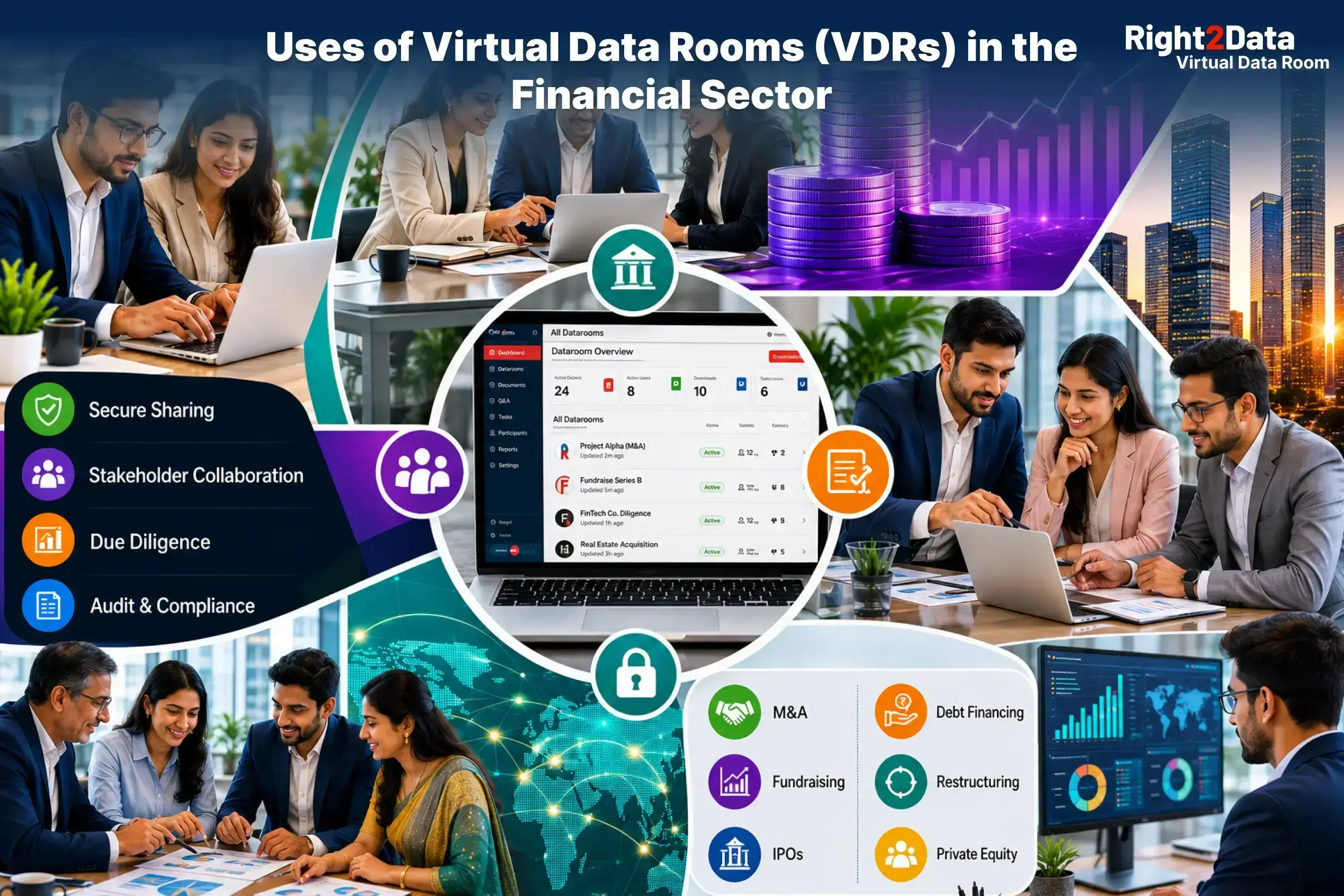 Uses of Virtual Data Rooms (VDRs) in the Financial Sector: What Financial Advisors Cannot Afford to Miss in a Modern Data Room